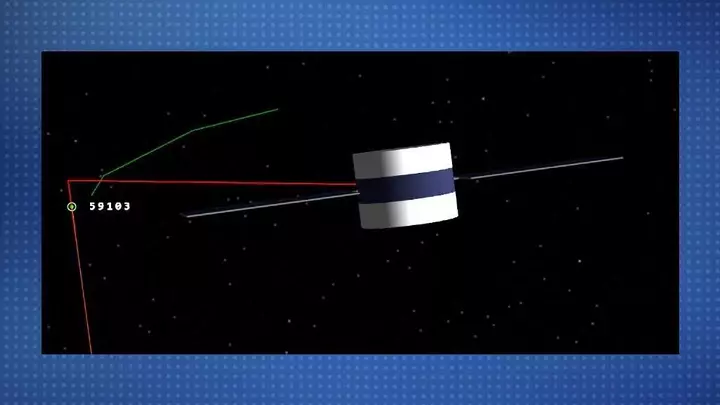
Has space become a new frontier in Russia's war with Ukraine? Russian military satellite Cosmos-2612 carried out a manoeuvre between October 15 and 18 that brought it “dangerously close” to Ukrainian commercial satellite, Iceye-X36. The move was described byUS Under Secretary of State for Arms Control and International Securityas "threatening".
Operated by Finnish company Iceye, Iceye-X36 is a Finnish-American civilian satellite equipped with Synthetic-aperture radar (SAR) to provide satellite images to the Ukrainian Armed Forces. The US State Department said Russia's tactic was consistent with “in-orbit military operations”. Analysts specialising in space surveillance have been following Cosmos-2612 since its launch in April.
"Cosmos-2612 was one of six satellites launched in total. It was immediately apparent that this wasn't a classic deployment. As soon as they took off, the satellites started changing orbit to pursue Iceye satellites,” said Norbert Pouzin, an orbital analyst at Aldoria, a French space surveillance firm.
Cosmos-2612 took off on April 6, 2026 alongside Cosmos-2609, Cosmos-2610, Cosmos-2611, Cosmos-2613 and Cosmos-2614.KeepTrack, a site specialising in satellite navigation, enables viewers to track their paths. This map shows the orbit carried out by Cosmos-2612 (identified by its Norad number 68762 in the screengrab) and other Cosmos satellites launched at the same time. © KeepTrack.space Orbit re-routing – as has been the case of the Cosmos satellites – is a move that consumes a lot of fuel. It’s also the first step in approaching another satellite, Pouzin explains: > "If two satellites are travelling in the same orbit, then they don’t need as much fuel to approach one another.
Changing directions in space uses a lot of fuel. But once in the same orbit as another satellite, you’ve already executed the most costly move fuel-wise, if you then want to carry out an approach.” As the imaging data via site,Satellite Tracker, corroborates, Cosmos-2612 diverted from its original position– around 400-500 km from Iceye-X36– to get closer to the Finnish-American satellite. "On October 15, Cosmos-2612 was within 5 kilometres of Iceye-X36.
Its position continued to narrow in on the satellite on October 16 and 17, before finally getting to within a few hundred metres and a kilometre of Iceye-X36,” Pouzin said. This chat shows the Cosmos-2612’s altitude (68762, shown in red) and Iceye-X36 (59103, shown in blue). You can see that Cosmos-2612 changed its position, moving to an altitude similar to Iceye-X36. © Satellite Tracker Satellite imaging company Vantor published a photo of the two satellites on October 22, depicting their orbits withing just 1.02 kilometres of one another.
Extract — continue reading at the source.