Across England, dozens of historic taverns claim to have poured pints longer than any of their competitors. Yet according to a recent forensic investigation, nearly all those ancient founding dates are myths brewed by shrewd landlords rather than historical reality. The findings follow a comprehensive architectural survey by James Wright, a buildings archaeologist working with Historic England.
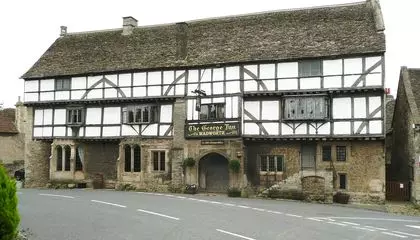
By analyzing surviving medieval timbers and cross-referencing historic documents, Wright tested the validity of more than two dozen establishments that claim the mantle of England’s oldest pub. To separate legend from architectural fact, Wright relied on dendrochronology, the science of dating through the growth rings of wooden timbers. He believes he has identified the true titleholder of England’s earliest surviving purpose-built inn: the George Inn in Norton St.
The analysis determined that the George Inn’s lower stone walls were constructed in the late 14th century by Carthusian monks from the nearby Hinton Priory. The monks expanded the inn during the early 15th century, adding an imposing timber-framed facade and roof framed with oak cut down between 1430 and 1432. During the Middle Ages, inns differed from everyday alehouses, which sold ale, and taverns, which served wine, per the Telegraph.
Purpose-built inns were substantial commercial hubs designed to provide beds, food and stables for traveling merchants. The George Inn served as a central storehouse for the priory’s wool trade and hosted merchants attending regional wool fairs, generating vital lodging fees, storage dues and sales tolls for the monks. In crowning the George Inn, Wright debunked several famous long-standing contenders.
Ye Olde Fighting Cocks in St. Albans, Hertfordshire, has frequently claimed an origin year of 793. However, archival research reveals that the octagonal timber structure was originally built as a monastic dovecote around 1400 and was not licensed as an alehouse until roughly 1807; its early medieval date appeared on a 20th-century tourist postcard.
Similarly, the Bingley Arms near Leeds claims a founding date of 953 and an entry in the Domesday Book of 1086. Yet its structure dates to the 18th century. Even Nottingham’s Ye Olde Trip to Jerusalem, which advertises an 1189 crusade-era pedigree, only first appears in licensing records (under the name “the Pilgrim”) in 1751.
Extract — continue reading at the source.