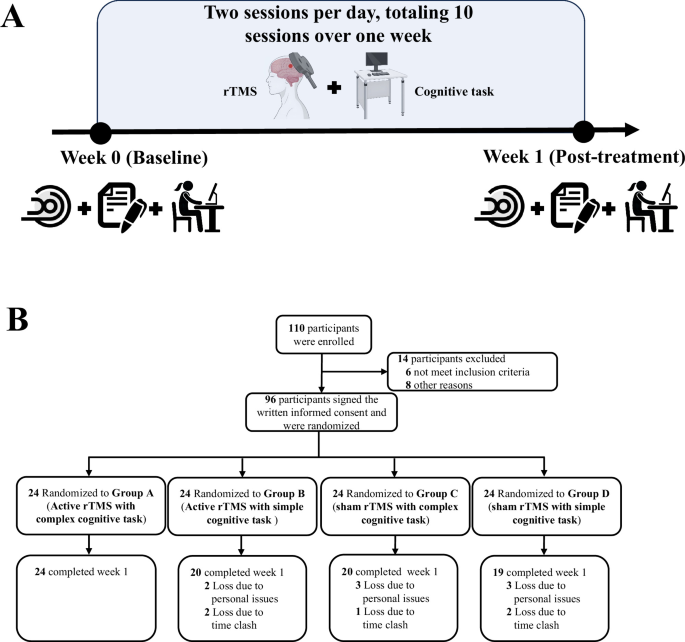
Repetitive transcranial magnetic stimulation (rTMS) is a promising neuromodulatory approach for cognitive improvement in psychiatric disorders. However, whether concurrent cognitive engagement enhances rTMS-related effects remains unclear. In this exploratory, randomized, double-blind, sham-controlled 2 × 2 factorial trial, 96 euthymic patients with bipolar II disorder and subjective cognitive impairment were assigned to active or sham 10-Hz rTMS combined with either a complex or simple cognitive task.
Stimulation targeted the left inferior parietal lobule (IPL) using robot-assisted neuronavigation and was delivered in 10 sessions over 5 consecutive days. The main outcomes included changes in working memory capacity and precision, subjective cognitive performance (Perceived Deficits Questionnaire, PDQ), and resting-state fMRI connectivity within hippocampal and IPL networks. Behavioral outcomes were analyzed using likelihood-based intention-to-treat linear mixed-effects models including time, stimulation, task condition, and their interactions.
False-discovery-rate correction was applied across behavioral outcomes. Eighty-three participants completed the trial. In the intention-to-treat analysis including all 96 randomized participants, no stimulation-by-task interaction survived correction for multiple comparisons.
Nominal interactions were observed for overall angular error and angular error at set size 2, but both fell short of the corrected significance threshold. The active rTMS and simple cognitive task group showed the most consistent model-estimated within-group improvements across several working-memory outcomes; however, these patterns did not establish superiority over the other factorial conditions. PDQ scores decreased across all four groups, without significant stimulation, task, or interaction effects.
Exploratory neuroimaging analyses indicated divergent functional-connectivity changes across intervention conditions. This exploratory trial did not provide statistically robust evidence that concurrent complex cognitive engagement enhanced the acute working-memory effects of IPL-targeted 10-Hz rTMS in euthymic bipolar II disorder, suggesting that task type, cognitive load, and stimulation–task coupling warrant further systematic optimization in future neuromodulation studies. ClinicalTrials.gov identifier: NCT06782763 This is a preview of subscription content, access via your institution Receive 12 print issues and online access Prices may be subject to local taxes which are calculated during checkout The datasets used in this study are from a clinical trial conducted at the First Affiliated Hospital, Zhejiang University School of Medicine, Hangzhou, China, and are not publicly available due to potential privacy concerns related to research participants.
Any additional information required to reanalyze the data reported in this paper is available from the lead contact upon request. Fu L, Ren J, Lei X, Zhang R, Zhang C. Effects of repetitive transcranial magnetic stimulation (rTMS) on cognitive impairment in depression: A systematic review and meta-analysis.
Extract — continue reading at the source.