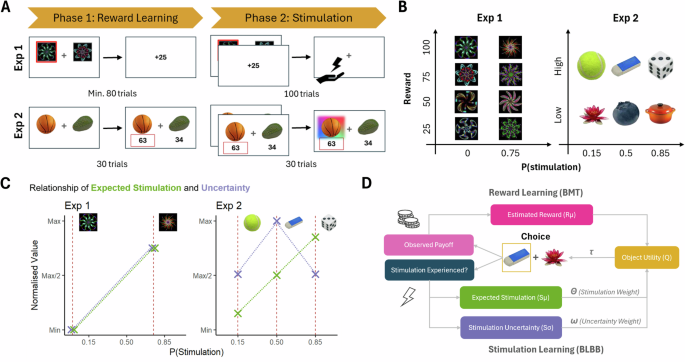
Sensation-seeking is often described as a tendency to pursue novel and stimulating experiences, yet such options are often uncertain as well. This creates a central ambiguity where choices that appear to reflect attraction to stimulation may instead reflect tolerance of uncertain outcomes, or an interaction between the two. Across two experiments, we tested how expected stimulation and stimulation uncertainty shape reward-guided choice.
A reanalysis of a previous operant sensation-seeking dataset suggests that stimulation uncertainty explained behaviour better than expected stimulation. Subsequently, we conducted a preregistered online experiment to investigate the joint effects of expected stimulation and stimulation uncertainty and to compare their respective associations with sensation-seeking and impulsivity. Our results indicate that higher sensation-seeking was associated with broader stochastic sampling and lower reward performance, but this was not reducible to random choice or uncertainty tolerance alone.
Instead, uncertainty weighting depended on the value assigned to expected stimulation. This profile differed from impulsivity, suggesting that the two traits shape choice through distinct computational routes. By separating expected stimulation from uncertainty, these findings refine accounts of exploratory choice by showing that sensation-seeking shapes not only how much people sample uncertain options, but how stimulation value and uncertainty are jointly weighted during choice.
Sensation-seeking is a personality trait characterised by the pursuit of “varied, novel, complex, and intense sensations and experiences,” even when these experiences carry potential costs1. It is associated with a broad range of exploratory and risky behaviours2,3, including alcohol and substance use4,5, antisocial behaviour6,7, and other maladaptive outcomes with substantial individual and societal costs8,9. Yet sensation-seeking is not uniformly harmful.
Higher sensation-seeking has also been linked to better psychological well-being10,11 and to forms of positive risk-taking, such as social exploration and pursuing challenging goals12,13,14,15,16. This duality suggests that sensation-seeking is not simply a general liability for risky behaviour, nor is it inherently beneficial. Its consequences may depend on the structure of the decision environment— whether novel or stimulating options provide useful information or long-term value, or instead compete with more immediately rewarding goals.
A prominent mechanistic explanation is that sensation-seeking reflects heightened valuation of stimulation. On this expected-stimulation account, high sensation-seekers assign greater subjective utility to actions that produce stimulating experiences17,18,19. This view is consistent with neurobiological accounts linking sensation-seeking to dopaminergic systems involved in incentive salience and reward learning17, as well as evidence that high sensation-seekers show distinct dopaminergic profiles, including elevated dopamine in the caudate nucleus and attenuated dopamine turnover rates20.
Extract — continue reading at the source.