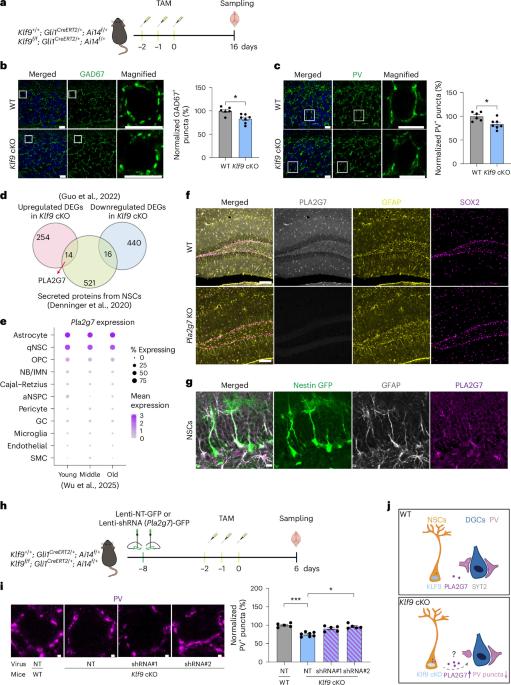
Age-related cognitive decline is associated with altered inhibitory signaling in hippocampal circuits, but the mechanisms underlying this dysfunction remain incompletely understood. Neural stem cells (NSCs) persist in the adult hippocampus and influence brain function beyond generating new neurons, although the molecular signals involved remain unclear. Here we show that phospholipase A2 group VII (PLA2G7), a secreted lipid-metabolizing enzyme expressed in NSCs, negatively regulates inhibitory circuit function in the dentate gyrus.
Conditional deletion of Pla2g7 in NSCs enhanced inhibitory inputs onto dentate granule cells and improved hippocampal cognition. Lipidomic profiling revealed PLA2G7-dependent remodeling of phospholipid composition, linking NSC-derived lipid metabolism to inhibitory synaptic regulation. Supplementation with phosphatidylcholine rescued PLA2G7-associated inhibitory synapse deficits.
In aged mice, PLA2G7 suppression restored inhibitory circuit function, partially normalized circuit imbalance and improved cognition. These findings identify a non-neurogenic mechanism through which NSCs modulate hippocampal circuits and suggest PLA2G7 as a target for promoting cognitive function during aging. This is a preview of subscription content, access via your institution Access Nature and 54 other Nature Portfolio journals Get Nature+, our best-value online-access subscription Receive 12 digital issues and online access to articles Prices may be subject to local taxes which are calculated during checkout All data are available in the main text and the supplementary materials.
Any additional requests for information can be directed to and will be fulfilled by the corresponding author. Source data are provided with this paper. B., Rajendran, L. & Gil-Mohapel, J.
The effects of aging in the hippocampus and cognitive decline. Tran, T., Bridi, M., Koh, M. T., Gallagher, M. & Kirkwood, A.
Reduced cognitive performance in aged rats correlates with increased excitation/inhibition ratio in the dentate gyrus in response to lateral entorhinal input. Aging 82, 120–127 (2019). Article PubMed PubMed Central Google Scholar Hainmueller, T. & Bartos, M.
Extract — continue reading at the source.


