What do Franz Kafka, Nikolai Gogol, and Modest Mussorgsky have in common? They stand alone among their peers for their darkly humorous sensibilities, fascination with the grotesque, imaginative takes on cultural traditions, and a predisposition for the proto-surreal. Like the odd figure lurching through the first movement of Mussorgsky’s Pictures at an Exhibition, they are gnomic artists: enigmatic and ambiguous, given to the aphoristic in stories and tone poems of monstrous and marvelous beings.
It’s easy to imagine the three of them, or their works at least, in cryptic conversation with each other. We might imagine that conversation as we watch three works by these major European artists—all of which we’ve featured on the site before—animated via the painstaking pinscreen method pioneered by husband-and-wife, Russian-and-French duo Alexander Alexeieff and Claire Parker. The two invented the technique in the 1930s.
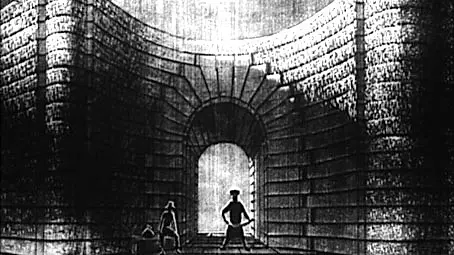
Dedicated to this extremely labor-intensive process, they made 6 short films over a period of 50 years, including adaptations of Kafka’s “Before the Law,” narrated by Orson Welles, Gogol’s “The Nose,” and Mussorgsky’s Night on Bald Mountain. We know the Mussorgsky piece as a terrifying vignette from Walt Disney’s Fantasia. Seven years before that marriage of classical music and animation came out in 1940, Alexeieff and Parker released their version, at the top.
Steve Stanchfield at Cartoon Research calls it “one of the most unusual and unique looking animated films ever created.” Its “delightful and at times horrifying imagery… challenge the viewer to comprehend both their meaning and the mystery of how they were created.” The same could be said of “The Nose” (1963), whose improvised soundtrack by Hai-Minh adds dramatic tension to the eerie animation. Each of these films uses the same method, a handmade pinscreen device in which thousands of pins are pushed by hand outward and inward for each frame to create areas of light or dark. The pair intended to move beyond the flatness of conventional cel animation techniques and capture the depth and contrast of chiaroscuro.
They achieved this through the most achingly slow process imaginable, yet “the illusion of dimensional drawing in animation has rarely been created better,” Stanchfield writes, not even in the most sophisticated computer-generated imagery. Alexeieff and Parker’s “Before the Law,” from a parable in Kafka’s The Trial, takes a picture-book approach to the animation that would reward younger viewers. Welles’ narration anchors the production with even more than his usual gravitas.
In 1972, they returned to Mussorgsky, in the short Pictures at an Exhibition, above. Here, after a prologue in French and the stylizations of the opening Prelude, the figure of “The Gnome” appears, a translucent homunculus hatching from an egg and dancing across the piano keys. I like to think Mussorgsky, Kafka, and Gogol would find this imagery irresistible.
Extract — continue reading at the source.