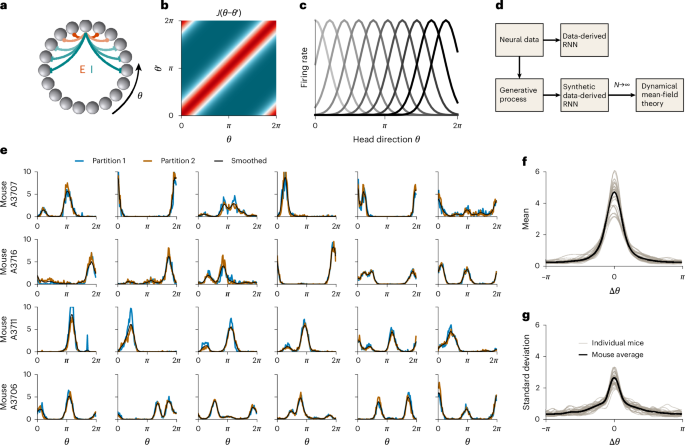
A core challenge in neuroscience is reconciling idealized models with experimental data. Classical continuous-attractor models describe neural representations of continuous variables such as head direction. Symmetry in the weights generates a manifold of stable states, with tuning curves identical up to shifts.
Rodent head-direction cells, by contrast, are markedly heterogeneous. Such heterogeneity, we show, is nevertheless compatible with these models. Here we build, directly from head-direction cell data, recurrent networks that behave as quasicontinuous attractors.
A generative process then reproduces the heterogeneous tuning of these cells while making connectivity and dynamics tractable at large N. Although the weights appear disordered, they carry a circular symmetry whose eigenvalue degeneracies could signify continuous-attractor organization in connectome data. Dynamical mean-field theory recovers the ingredients of classical ring attractors, namely, Mexican hat interactions and a spontaneously broken symmetry producing bump states.
Continuous-attractor mechanisms may thus operate in complex mammalian circuits. This is a preview of subscription content, access via your institution Access Nature and 54 other Nature Portfolio journals Get Nature+, our best-value online-access subscription Receive 12 print issues and online access Prices may be subject to local taxes which are calculated during checkout The raw electrophysiological and behavioral recordings analyzed in this study were collected by Duszkiewicz et al.16 and are publicly available from the DANDI Archive as Dandiset 000939 (ref. 39). The cached intermediate results used by the analysis notebooks are publicly available via Zenodo at https://doi.org/10.5281/zenodo.21827768 (ref. 72).
Every cached file is regenerable from the raw data and the released code. All analysis code is publicly available as an installable Python package, ring, together with 11 Jupyter notebooks that generate every figure in the paper, apart from two panels of the grid-cell figure that reproduce experimental data from previously published studies. The code is released under the MIT License and is available on GitHub at https://github.com/davidclark1/symmetries-continuous-attractors, archived on Zenodo at https://doi.org/10.5281/zenodo.21829584 (ref. 73).
Analyses were run under Python 3.12 with NumPy 1.26.4, SciPy 1.13.1, Matplotlib 3.8.4, PyTorch 2.4.0, pynwb 2.6, Astropy 6.1 and statsmodels 0.14, and the full environment specification is distributed with the code. Attractor and integrator networks in the brain. Neurosci. 23, 744–766 (2022).
Extract — continue reading at the source.


