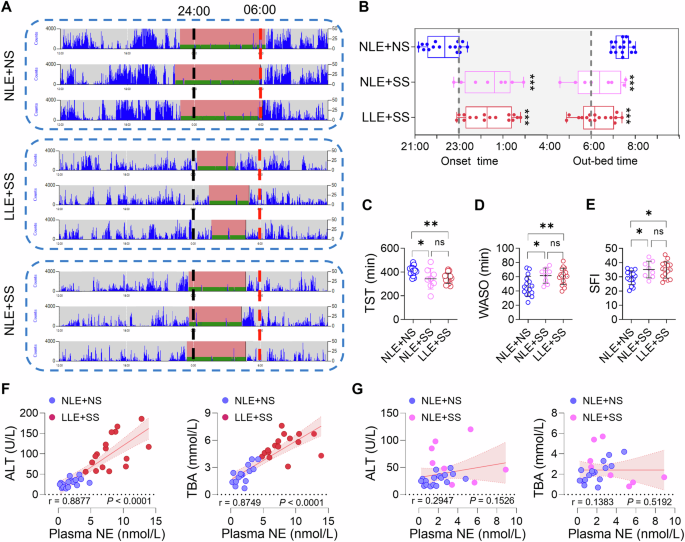
Prolonged light exposure and rest-activity alteration are increasingly prevalent in modern society, yet their health consequence and the underlying mechanism remain poorly characterized. The liver is an organ central to metabolic and circadian regulation. We hypothesized that extended wakefulness, which was modeled as long photoperiod in humans and short photoperiod in nocturnal mice, would affect liver integrity and function.
Actigraphic watch, wheel running, morphological, biochemical, transcriptomic, and chromatographic techniques were employed to examine the impact of light exposure alteration. To reverse the circadian disorders mediated by the sympathetic nervous system (SNS) activation, SNS inhibitor or time-restricted feeding was applied. In both humans and mice, extended wakefulness increased daily activity and reduced rest, as well as inducing tissue injury exclusively in the liver and predominantly affecting bile acid metabolism.
Mechanistically, short photoperiod enhanced hepatic sympathetic innervation and activity in mice, activating a norepinephrine–β2-adrenergic receptor–protein kinase A signaling axis that reprogrammed the hepatic circadian clock and bile acid metabolism. Chemical sympathectomy not time-restricted feeding restored bile acid rhythmicity and alleviated liver injury. These findings identified the liver as a primary target of circadian disruption and established elevated sympathetic tone as a key mediator linking extended light exposure to metabolic dysfunction.
Circadian rhythm is orchestrated by a hierarchical system comprising the central pacemaker in the suprachiasmatic nucleus (SCN) and peripheral clocks in other tissues1,2. Light serves as a dominant entraining cue for the SCN, which synchronizes with the peripheral clocks through neural and hormonal outputs3. Among these, the autonomic nervous system plays a critical role, with sympathetic signaling modulating peripheral clock function via rhythmic release of norepinephrine (NE)4,5.
In contrast, feeding behavior acts as a potent zeitgeber for peripheral tissues, particularly the liver6,7. Besides circadian rhythm, animals also respond to seasonal changes in light exposure, i.e., photoperiod. Photoperiod-dependent light changes alter SCN activity and downstream signaling, thereby influencing metabolic processes and clock gene expression in peripheral tissues8.
In modern societies, sleep deficiency and prolonged light exposure, as a result of extended artificial lighting and behavioral factors, are increasingly prevalent and are key drivers of circadian misalignment, which increases the incidence of physical and mental diseases9. The liver, a central hub for metabolic regulation, exhibits robust circadian oscillations that coordinate lipid, glucose, and bile acid homeostasis. Disruption of hepatic circadian rhythms triggers liver diseases including nonalcoholic steatohepatitis and hepatocellular carcinoma10.
Extract — continue reading at the source.


