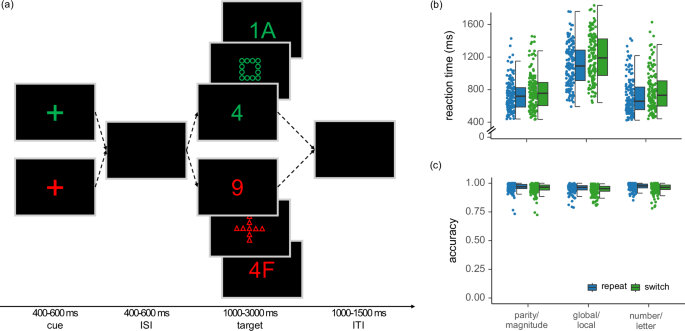
Cognitive flexibility–the ability to adapt to changing situational or task demands–is a fundamental aspect of human cognition and a potential source of individual differences in higher-order cognitive abilities. To further understand the neural mechanisms underlying this ability, we examined event-related spectral perturbations (ERSP) in three cued switching tasks (parity/magnitude, global/local, number/letter) in a sample of 148 adults. Employing a data-driven approach that combined mass-univariate time-frequency analysis, cluster-based permutation testing, and latent change structural equation modeling, we identified two robust neural signatures: a transient frontal theta increase and a sustained alpha/beta suppression.
Both effects were more pronounced in switch compared to repeat trials. Frontal theta reflected task-specific control processes, whereas parietal alpha/beta indexed domain-general attentional processes that persisted from cue onset through target processing–consistent with two-stage models of task switching. Notably, flexibility-related alpha/beta dynamics did not correlate with measures of intelligence or working memory capacity.
However, stronger cue-elicited alpha/beta suppression correlated with reduced non-decision-time switch costs, indicating more effective task preparation, underscoring that alpha/beta suppression captures a neurally coherent but behaviorally distinct dimension of cognitive flexibility. These findings provide evidence that alpha/beta suppression constitutes a reliable, cross-task generalizable neural signature of attentional reconfiguration during task switching, while highlighting the multi-component nature of individual differences in cognitive flexibility. Cognitive flexibility is a key element of human behavior that enables us to adapt to changing circumstances—whether switching between different tasks during the working day1 or generating creative solutions to novel problems2.
We define cognitive flexibility as the ability to adapt to changing task demands by switching between mental sets or rules3. As a core component of an influential—though contested—executive function model4,5, alongside inhibition and updating, cognitive flexibility is theorized to underlie more complex goal-directed processes such as planning and problem-solving. Yet while cognitive flexibility represents a fundamental capacity for adaptive behavior, individuals show marked differences in their flexibility abilities, and understanding these individual differences remains a central challenge in cognitive psychology.
Individual differences in cognitive flexibility have profound implications across multiple domains of human functioning. They predict meaningful real-world outcomes such as academic achievement6,7, problem-solving capabilities8, social interactions9, and mental health outcomes10. Conversely, reduced cognitive flexibility characterizes numerous clinical populations, including individuals with schizophrenia11, depression12, and autism spectrum disorder13.
Some researchers propose that individual differences in cognitive flexibility may even explain the positive correlations observed across diverse cognitive tasks, as most complex cognitive operations require some degree of flexible adaptation14,15. For example, the process overlap theory14 posits that domain-general cognitive processes, such as core executive functions, act as bottlenecks that cause the positive manifold. In contrast, resource-based frameworks16 conceptualize core executive functions as limited resources, predicting that individuals with greater resources will perform better.
Extract — continue reading at the source.


