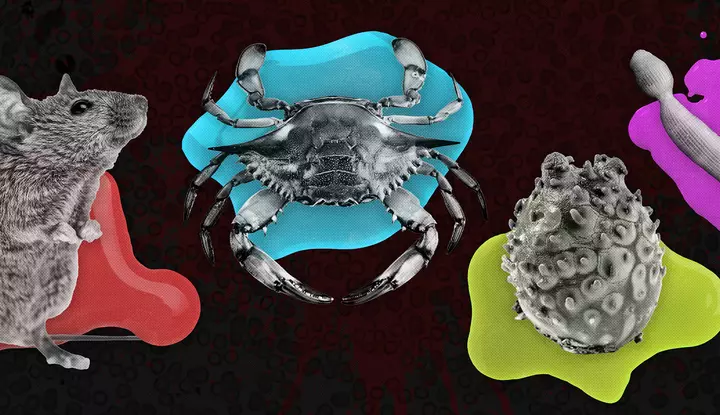
Scientists have made some headway in understanding what lends blood its varied shades. Red isn’t the only color when it comes to blood — critters produce the vital fluid in a variety of hues Whether it’s gushing from a bumped nose or pooling atop a pricked finger, our blood is some hue of red. But red-bloodedness isn’t universal in the animal kingdom.
In some creatures, the vital fluid is purple, in others it’s yellow, green or even white. What imparts these different colors to the liquid of life? To find out, _Knowable_ _Magazine_ waded into the research and spoke with a couple of scientists who have studied the stuff: John Postlethwait, a developmental geneticist at the University of Oregon, and Zachary Cheviron, an ecophysiologist at the University of Montana.
Here’s what’s known about the science behind the hues. The rich red of vertebrate blood comes from hemoglobin, a protein in red blood cells that contains iron atoms. Hemoglobin’s job is to deliver oxygen, and its iron atoms, which grab onto oxygen, make our blood look red.
When iron atoms are attached to oxygen, blood is a bright cherry red; when less oxygen is bound it’s a muddier brown-red. But many creatures don’t use hemoglobin. Octopus and squid, for example, and crustaceans such as shrimp and crabs, rely on a protein called hemocyanin to ferry oxygen around.
Hemocyanin has copper atoms — which look blue when bound to oxygen — instead of hemoglobin’s iron. Hemocyanin doesn’t bind to oxygen as efficiently as hemoglobin does. But it functions especially well in cold temperatures, such as those found in the deep ocean.
And it can have more jobs than carrying oxygen in the creatures that use it — research suggests that hemocyanins can play an immunity role, aiding in healing wounds, for example. Horseshoe crabs (left) bleed blue, thanks to copper-rich hemocyanin, while icefish (right) don’t use an oxygen-carrying protein and bleed ghostly white. CREDITS: _RECHERCHES SUR L’ANATOMIE DES LIMULES_ 1873 (LEFT); _ANTARCTIC FISHES OF THE SCOTTISH NATIONAL ANTARCTIC EXPEDITION_ 1913 (RIGHT) / PUBLIC DOMAIN Other marine creatures, such as clam-like brachiopods and the seafloor dwelling peanut worm, bleed violet — but not because of hemocyanin.
Extract — continue reading at the source.