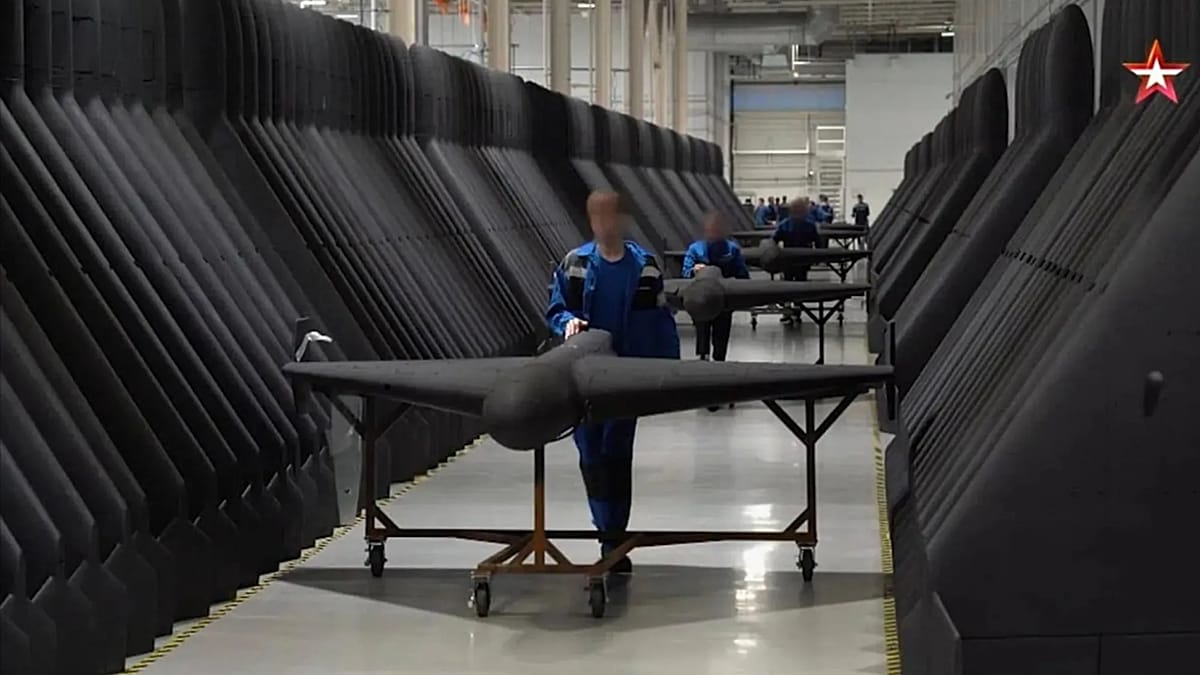
After more than four years of war between Russia and Ukraine, technology and spending on military equipment have evolved significantly. A number of Russian drones have been detected flying over European Union territory. There have been incursions into Poland and Bulgaria although, according to a CIA report, the situation could become more complicated.
The latest information from the CIA has made it clear that there is a risk of Russian drone attacks on Spain, France or Italy launched from containers on ships belonging to the shadow fleet in the Mediterranean. So, what kind of drones is the Russian army using? According to the latest information from the Ukrainian military, it goes far beyond the use of Iranian-made Shahed drones.
In the early hours of 27 August, Ukrainian air defences shot down or neutralised 233 Russian targets in a single night-time bombardment. Among them were 258 attack drones, two Oniks anti-ship missiles and several Iskander-M and KN-23 ballistic missiles. According to the Ukrainian Air Force, around a third of those drones are jet-powered, while the rest are a mix of Shahed-type drones, Gerbera systems and Banderol missiles, as well as decoys.
That mix gives a fairly accurate picture of the state of Russia’s unmanned arsenal at this stage of the war: it is no longer based on a single model but on a whole family of systems performing different roles, from flooding the sky with cheap swarms to punching through at more than 500 kilometres per hour. Part of the explanation lies in cost. Firing a million-dollar interceptor at a drone worth between €25,000-40,000 (€21,000-35,000) is unsustainable in the long run and that imbalance is precisely what Moscow is exploiting by launching waves capable of exhausting far more expensive air-defence systems with its drones, as well as with more conventional weapons.
The bulk of this drone fleet comes from the Alabuga Special Economic Zone in Tatarstan, some 1,200 kilometres from the Ukrainian border. The complex covers more than 2.8 million square metres and it is estimated that around 15% of its facilities are devoted, directly or indirectly, to war production. There, composite fuselages are moulded, engines are manufactured, onboard electronics are assembled and completed parts are stored.
Ukrainian strikes on the complex have forced Russia to move much of that chain underground. A Ukrainian open-source analyst estimates that around 42,000 square metres of underground space have already been built at Alabuga, the equivalent of six football pitches. According to Russian media cited by 'The Economist', daily production of Geran-2 drones already exceeds 100 units, with plans to reach 500 a day.
Extract — continue reading at the source.