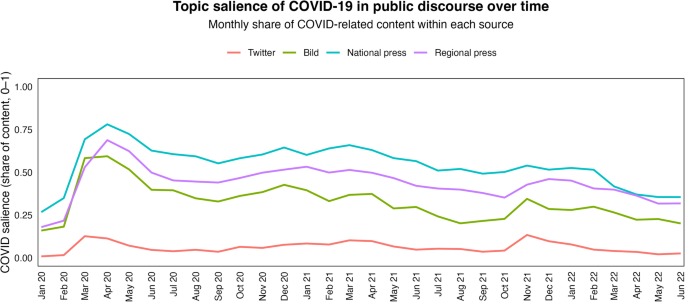
The COVID-19 pandemic disrupted healthcare systems worldwide, leading to substantial declines in preventive service utilization. We examine whether public discourse about COVID-19, measured as sentiment and topic salience on Twitter and in German newspapers, was associated with healthcare utilization in Germany between 2020 and 2022. Using computational text analysis and fixed-effects panel regressions of administrative outpatient data, we link monthly discourse measures from national and regional newspapers, Bild, and geolocated Twitter posts to utilization changes across screenings, vaccinations, chronic care, and psychotherapy.
More positive sentiment and higher COVID salience were generally associated with lower use of discretionary services such as cancer screenings and group psychotherapy. By contrast, influenza and pneumococcal vaccination uptake increased when COVID-related attention was higher, particularly on Twitter and in Bild. Associations varied by media source, indicating that salience and evaluative tone capture distinct aspects of the information environment that relate differently to healthcare behavior.
The COVID-19 pandemic put exceptional pressure on healthcare systems and disrupted routine medical care far beyond services directly related to COVID-19. Evidence from a range of countries (including Germany) shows substantial declines in the use of healthcare services during the pandemic, especially in its early phases1,2,3,4,5,6,7. Utilization of preventive care such as cancer screening and routine vaccinations declined, and participation in programs for chronic conditions was reduced8,9.
These disruptions raise concerns about delayed diagnoses, missed prevention opportunities, and ultimately worse longer-term health outcomes, making it important to understand not only when utilization fell, but also what shaped care-seeking decisions under pandemic conditions and thus how care-seeking behavior can be encouraged. Most explanations for these declines in healthcare utilization emphasize structural and epidemiological conditions, such as changes in provider capacity10,11, restrictions on mobility12,13, and perceived infection risk in healthcare settings14,15,16,17. At the same time, decisions about seeking care are shaped by the information environment in which people interpret risks and make choices.
Throughout the pandemic, people were exposed daily to news reports and social media discussions about case numbers, deaths, hospital pressure, vaccination debates, and policy conflicts18. Such communication does not only inform; it can also shape perceived threat, trust in institutions, and the perceived safety of healthcare settings19,20,21,22,23. Empirical studies that link public discourse to healthcare utilization beyond COVID-specific care remain rare.
While linguistic and communication research has documented how COVID-19 was discussed across government statements, traditional media, and social media, including sentiment trends and emotional framing24,25,26, as well as shifting topic structures and metaphors27, and politicized or conspiratorial narratives28,29, it rarely tests whether discourse dynamics translate into measurable changes in healthcare-seeking behavior. A related but distinct line of research in infodemiology demonstrates that social and traditional media signals can track and sometimes predict disease dynamics, with successful applications to outbreaks such as influenza, measles, and Zika30,31,32,33,34,35,36. These studies establish the predictive value of discourse-based indicators for epidemiological monitoring, but they typically do not connect news coverage and social media discourse to administrative utilization outcomes.
Extract — continue reading at the source.