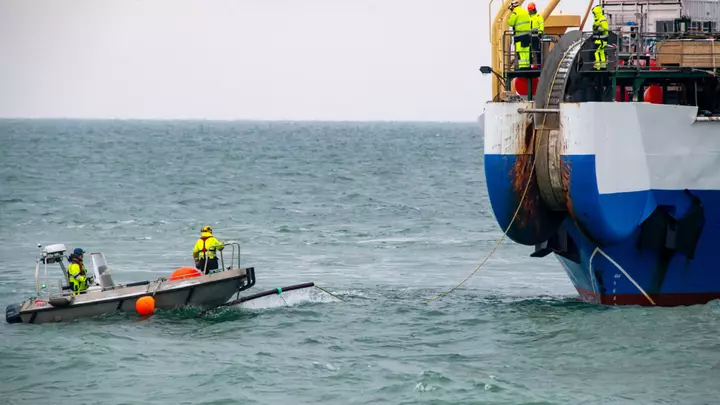
Despite the expansion of Starlink and other communications satellite services, most of the world’s Internet traffic still travels through subsea cables crisscrossing the ocean floors. Those fiber-optic cables coexist with a network of oil and gas pipelines and submarine power cables—and all these crucial links connecting countries and continents now face growing sabotage risks as gray-zone warfare and open conflicts have become widespread. The rising risks to the world’s invisible infrastructure beneath the waves are the main subject of a new book by Elisabeth Braw, a senior fellow at the Atlantic Council who leads the Threats to the Global Maritime Order Initiative.
Her book, titled Undersea War, explores the modern rise in suspicious incidents in which ships dragging their anchors for unusually long periods have cut or damaged undersea cables and pipelines from the Baltic Sea to the Pacific Ocean. Braw acknowledges that about 60 percent of undersea cable damage is primarily due to human error during fishing and shipping activities, when weighted nets or anchors drag across the seabed. Natural hazards such as storms and undersea landslides also account for a smaller proportion of such incidents.
In total, between 150 and 200 cables are damaged each year and usually repaired quickly. But international tension between superpowers and open war in Europe and the Middle East have led to increased scrutiny of cable-cutting incidents, with governments investigating and sometimes prosecuting crews for allegedly causing deliberate damage to subsea cables. One of the more notorious incidents documented in the book is the “Christmas Day massacre” of 2024, when a Russian-linked oil tanker named Eagle S dragged its anchor across the seabed for about 56 miles (90 kilometers), cutting or damaging four data cables and the Estlink 2 submarine power cable connecting the Baltic and Nordic power grids.
One of those data cables had also previously been severed by the Chinese cargo ship Yi Peng 3 just one month earlier in November 2024, when that ship damaged two data cables in the Baltic region. That ship’s crew was not prosecuted by European authorities, whereas the Finnish government has attempted to prosecute three senior officers of the Eagle S.
Extract — continue reading at the source.