We have any number of reasons for difficulty getting to sleep, not least worries about the future. This is hardly a recent phenomenon, and indeed practices meant to clarify the nature of events to come may be older than civilization itself. In fact, many of us moderns trust the old ways of fortune-telling more than the new.
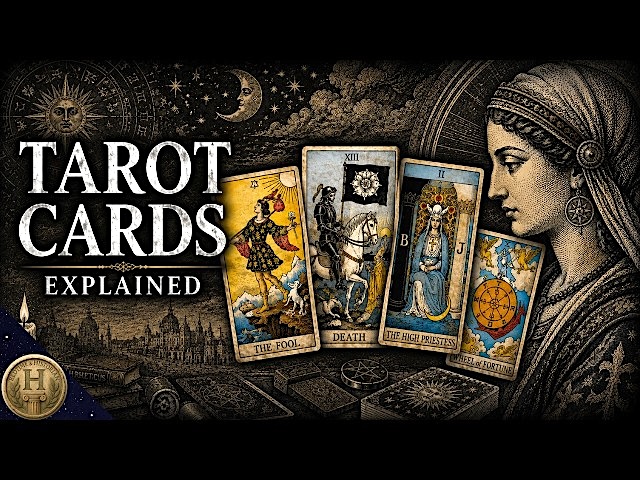
Take the cards of the Tarot, often featured here on Open Culture, whose recognizable European form dates back to at least the fourteenth century. But as explained in the new video above from YouTube channel Bedtime & Historian, their pre-history begins longer ago and farther away, with the invention of the playing card itself in Tang-Dynasty China. For Tarot decks weren’t originally a means of glimpsing the future, but of passing time in the present.
In the 400 years or so between the civilizational journey playing cards made along the Silk Road and their first employment as a divination tool by French occultists, many a game of Tarot — or tarocchi, Tarock, and so on — took place in Europe. Monetary stakes, and sometimes considerable ones, were not unknown, which drew the ire of both state and Church authorities. Yet not only did the cards survive these attempts at repression, they evolved along numerous long and winding cultural paths, taking artistically elaborate and evocative forms that still capture the imagination today.
At the same time, the structure of the Tarot deck used by esotericists has remained remarkably stable, with its 78 cards consisting of 22 Major Arcana and 56 Minor Arcana, the latter divided into four suits (like the standard deck used for poker or blackjack). If you aren’t sure what some of those terms mean, know that all is clarified over the course of the video’s nearly three-hour runtime, the final third of which is dedicated to explaining the identities, characteristics, and meanings of the cards themselves. It’s worth a listen as a kind of advance preparation if you’ve considered going in to get a Tarot reading done by one of the professionals who still ply their trade all around the world. (In Korea, where I live, they even work out of booths set up on the sidewalk, a true convenience for commuters in need of spiritual guidance on the way home.) True to Bedtime & Historian’s concept, the narrator speaks as slowly and calmly as possible, with a fire crackling in the background.
You’ll learn a lot about Tarot, certainly, but you may also find that your sleep troubles have been solved before you’ve drawn your first card. Behold the Sola-Busca Tarot Deck, the Earliest Complete Set of Tarot Cards (1490) The Artistic & Mystical World of Tarot: See Decks by Salvador Dalí, Aleister Crowley, H.R. Giger & More Alejandro Jodorowsky Explains How Tarot Cards Can Give You Creative Inspiration Carl Jung on the Power of Tarot Cards: They Provide Doorways to the Unconscious & Perhaps a Way to Predict the Future Divine Decks: A Visual History of Tarot: The First Comprehensive Survey of Tarot Gets Published by Taschen Based in Seoul, Colin Marshall writes and broadcasts on cities, language, and culture.
He’s the author of the newsletter Books on Cities as well as the books 한국 요약 금지 (No Summarizing Korea) and Korean Newtro. Follow him on the social network formerly known as Twitter at @colinmarshall. by Colin Marshall | Permalink | Comments (0) | We’re hoping to rely on our loyal readers rather than erratic ads. To support Open Culture’s educational mission, please consider making a donation.
Extract — continue reading at the source.