How did the Nazi Volkswagen become the world-renowned symbol of postwar, post-fascist Germany? In a country with little car ownership, the KdF-Wagen was promoted as an affordable vehicle for the Volk (people). It was presented as the automotive flagship of a “racially defined Volksgemeinschaft” (people’s community); Jewish Germans were not allowed to purchase one.
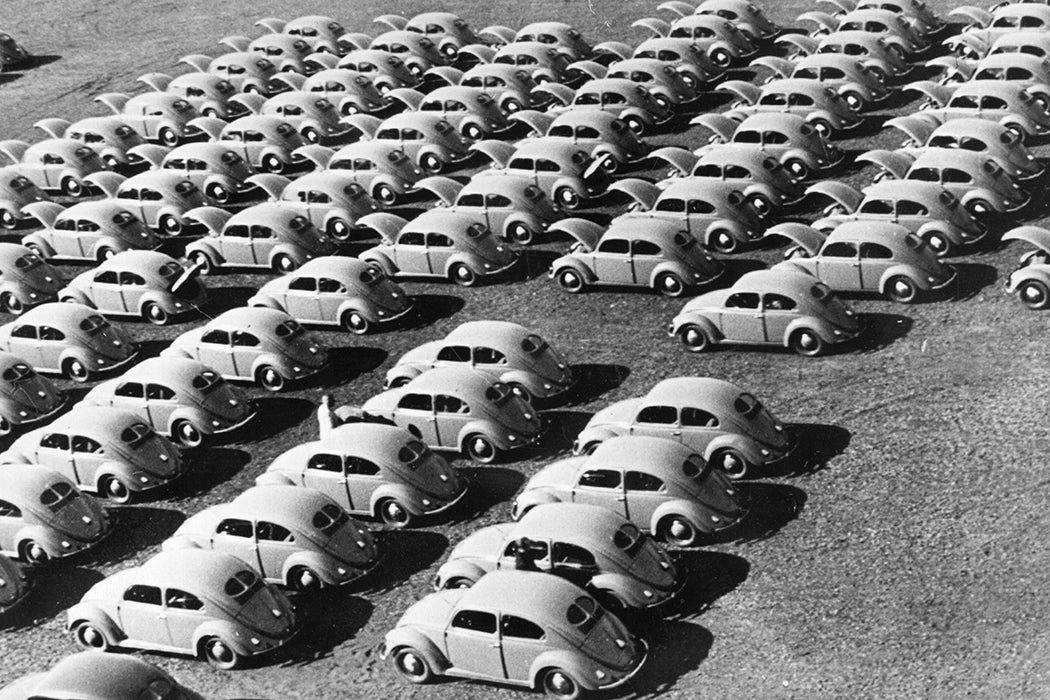
KdF-Wagens were supposed to be produced in a new, purpose-built factory town given the utilitarian name Stadt des KdF-Wagens. The enormous facility, later known as Wolfsburg, was planned to produce 1.5 million cars annually. The basic price in 1938 was 990 Reichsmarks (RM).
An installment plan meant people could invest 5 RM at a time, receiving special stamps to show their payments. The idea was to fill four 250 RM stamp books and then turn them in for a vehicle. But here’s the thing about investing in totalitarianism: it’s a sucker’s game.
Hitler, the car’s biggest booster, unsurprisingly got one of the very few produced. For everyone else, the promised car never materialized. From 1939 until 1945, the Wolfsburg factory was given over to military vehicles and munitions, even as the regime continued to promote the unavailable civilian car.
It would take thirty years for Volkswagen to finally settle the last of the 120,000 claims from those who had purchased the stamps. After the war, a British engineer led the effort to bring the Wolfsburg plant back online. When production increased for the VW Type 1 in 1948, writes Scholz, “it was the first time that the car as it was originally conceived became a mass-produced reality, populating German streets.” Since it looked like a ladybug, the Type 1 was called the Käfer, which is German for beetle.
In English, it was affectionately known as the Bug or Beetle. Names in other markets included Vocho, Coccinelle, Fusca, and Maggiolino. Over 21.5 million were made, a world record for number of units and years of production.
Extract — continue reading at the source.