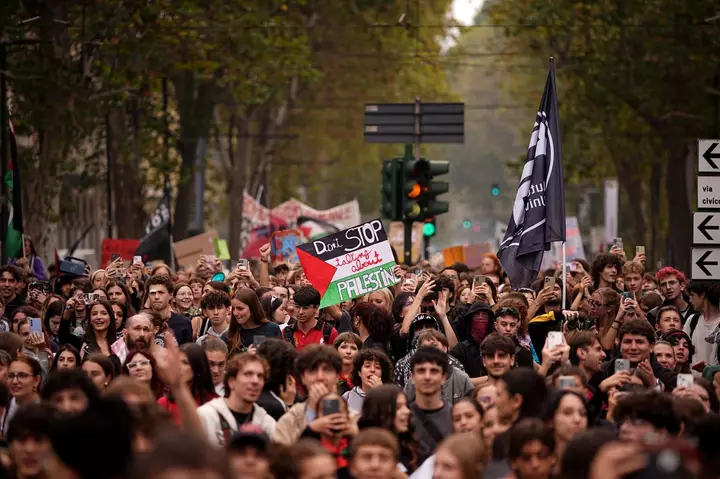
On Saturday, October 17, protesters climbed the statue of Marianne in Paris's Place de la République. Below them, demonstrators railed against soaring living costs and expensive fuel, while elsewhere in the capital, cars burned and riot police fired tear gas. Above the crowd, two flags fluttered side-by-side: the French tricolor and the Palestinian flag.
The French flag made sense, bien sûr. And although the Palestinian flag has become so ubiquitous at demonstrations that its appearance scarcely raises an eyebrow, understanding what it was doing there still required a considerable leap of imagination. What exactly does Gaza have to do with the price of gas in Paris?
Or the sorry state of French schools? Here lies perhaps the most remarkable achievement of the Palestinian national movement: after decades of demanding a free Palestine, its supporters have indeed achieved liberation, albeit of a peculiar kind that the originators of the now-incessant chant “Free Palestine!” probably never imagined. The land of Palestine, however one chooses to define it, remains contested, its future unresolved.
Yet the Palestinian cause has escaped the inconvenient confines of geography. It has slipped its borders, shed its specificity and emerged as a universal emblem of righteous indignation. Palestine has indeed never been freer.
You can now find it anywhere, protesting anything. Palestine has been freed from geography itself. The transformation has been years in the making.
In November 2023, activists unfurled an enormous Palestinian flag from Italy's Leaning Tower of Pisa. Colored smoke billowed around the medieval monument as the banner hung from its famous incline. The demonstration concerned Israel's war in Gaza, but the image suggested something grander: Palestine had become a cause entitled, apparently, to turn Europe's most treasured landmarks into its personal billboards.
Extract — continue reading at the source.