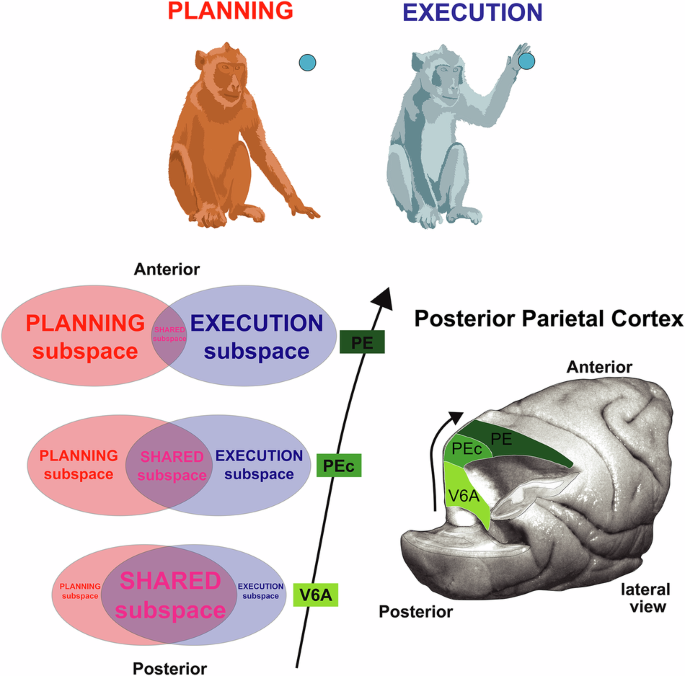
The posterior parietal cortex (PPC) plays a central role in movement control, performing visuomotor transformations, supporting planning, and providing sensory feedback for movement guidance. However, it is unknown how the neural populations in several PPC areas organize their activity during these processes. PPC activity has been proposed to show distributed population dynamics rather than fixed, distinct neural subpopulations dedicated to planning or execution.
This raises the question of how the same neural population reconfigures its activity between these two main phases of motor control. To address this, we analyzed neural dynamics in three PPC areas (PE, PEc, V6A) during a delayed reaching task, applying dimensionality reduction methods. This approach identifies whether activity in each area is organized into independent or partially overlapping dynamics across task phases.
We found area-specific population subspaces, distinct for movement planning and execution. Specifically, all three areas showed both shared and exclusive subspaces, but cross-epoch coupling and subspace sharing were weaker in PE than in V6A and PEc. Overall, our findings show that different PPC areas balance separate and shared neural activity patterns across movement planning and execution, highlighting distinct contributions to sensorimotor control.
We would like to thank Prof. Margherita Porcelli for her helpful comments and Marco Marcantoni for hand-drawing the monkey illustrations used in the Graphical Abstract. I.P.S. and P.F. disclose support for the research reported in this work from the European Innovation Council (EIC) under the European Union’s Horizon 2020 research and innovation program, MAIA (grant agreement no. 951910; H2020-EIC-FETPROACT-2019-951910).
I.P.S. also discloses support for the research reported in this work from the European Research Council (ERC), ThinkAhead (grant agreement no. 820213), and the CNR-ISTC project “From Intention to Action”.P.F. also discloses support for the research reported in this work from MNESYS (PE0000006), “A Multiscale Integrated Approach to the Study of the Nervous System in Health and Disease”, funded by the European Union – NextGenerationEU. National Research Council of Italy (CNR), Institute of Cognitive Sciences and Technologies (ISTC), Padova, Italy University of Bologna, Department of Biomedical and Neuromotor Sciences, Bologna, Italy Francesco Edoardo Vaccari, Kostas Hadjidimitrakis & Patrizia Fattori Correspondence to Stefano Diomedi or Ivilin Peev Stoianov. The authors declare no competing interests.
During the preparation of this work, the author(s) used Generative AI in order to correct typographical errors and lightly edit language for clarity. Publisher’s note Springer Nature remains neutral with regard to jurisdictional claims in published maps and institutional affiliations. Open Access This article is licensed under a Creative Commons Attribution-NonCommercial-NoDerivatives 4.0 International License, which permits any non-commercial use, sharing, distribution and reproduction in any medium or format, as long as you give appropriate credit to the original author(s) and the source, provide a link to the Creative Commons licence, and indicate if you modified the licensed material.
Extract — continue reading at the source.


