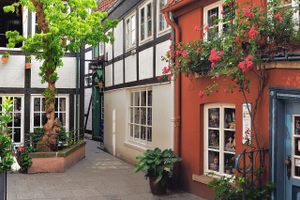
This is Bremen’s oldest historic district, famous for its labyrinth of narrow medieval alleys lined with tiny, colorful 15th-century houses that resemble beads on a rope. The Schnoor is Bremen at its most storybook-like: a tangle of narrow Harry Potter-like lanes where tiny, slightly crooked houses seem to lean in for a chat. As the city’s oldest quarter, it turns an ordinary walk into a slow-motion treasure hunt for colorful façades, hidden courtyards, handmade finds, and excellent excuses to stop for cake.
Named for the Low German word for “string,” the neighborhood’s small homes sit close together like beads threaded along its winding streets. Many date from the 15th and 16th centuries, giving the area an enchanting, human-scale character that feels wonderfully removed from the city bustle just a few minutes away. Today, the Schnoor is far more than a pretty backdrop.
Its former fishermen’s and craftspeople’s quarter is filled with independent craft shops, galleries, cafés, patisseries, and little cultural surprises, including a theatre and the Bremer Geschichtenhaus museum. The best plan is not to make one. Wander without rushing, peek down every alley that looks too narrow to be useful, and accept that getting pleasantly sidetracked is the whole point.
The Schnoor proves that sometimes the most memorable route through a city is the one with barely enough room for two umbrellas. Get more unusual and extraordinary places each week with the Atlas Obscura Places newsletter. Your newsletter subscriptions with us are subject to Atlas Obscura's Privacy Policy and Terms of Use.
These two 15th-century metal rods allowed people to check if they were swindled or not. When a supermarket opened up shop within a medieval building it became protected by UNESCO on a technicality. A pristine medieval church that was visited by Columbus before his travels to the Americas.
This 12th-century gatehouse has survived England’s many religious upheavals An architectural anomaly that preserves the chilling history of medieval ascetics who chose to be buried alive. A unique shopping and dining park created from old shipping containers and filled with local businesses. Ruins of a church in a peaceful location overlooking fields.
Extract — continue reading at the source.