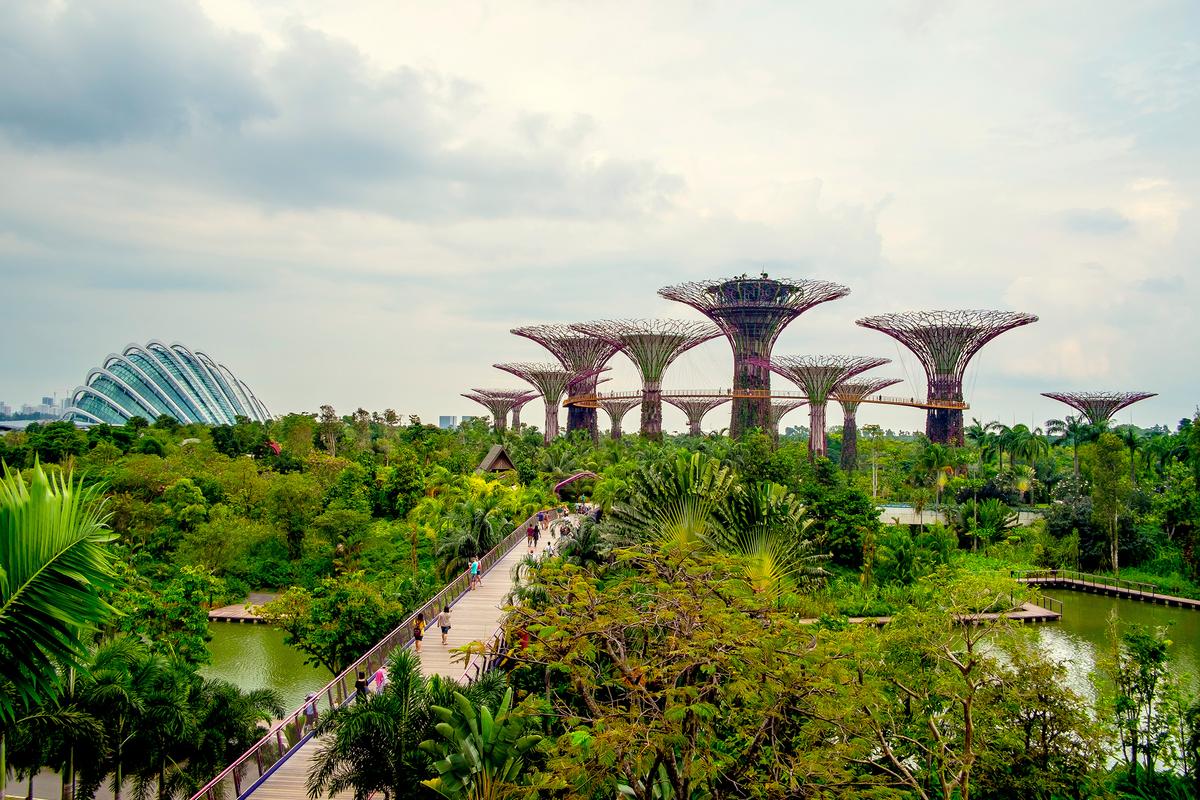
Climate-controlled conservatories and Supertrees at Gardens by the Bay, Singapore. Photo by Carlos Spottorno/Panos In May 2010, I was invited to Brunei to give two lectures on agriculture. At the time, the government there had just launched a plan to become more self-sufficient in rice production to promote greater ‘food security’ – a goal Brunei still holds today, along with greater ‘sustainability’.
After one of my lectures, I was asked by a journalist what I thought of the plan. My sense at the time was that this plan was wrongheaded, and I said so. Brunei is a tiny, super-wealthy sultanate composed mainly of tropical rainforest on the ecologically fragile island of Borneo.
The country’s wealth was (and still is) based overwhelmingly on oil and natural gas. I suggested that the sultanate carry on with carbon, and purchase the rice it needed from neighbouring countries in Southeast Asia, which is, after all, the buckle of the world’s rice belt. In other words, pursue your comparative advantage, rather than divert resources to produce a cheap, basic commodity relatively inefficiently on bad soil in an unsuitable setting.
Alas, the country is still plugging away on its rice plan, which hasn’t gone all that well. After years of assiduous efforts and considerable investment, in 2024 Brunei produced 8 per cent of the rice it consumed, up from 4.8 per cent in 2017, which means it is still a long way from self-sufficiency. Fortunately for Bruneians, the sultanate easily gets all the rice it needs from neighbouring countries, as Southeast Asia has long been a rice-surplus region.
I would argue that, if Brunei remains insistent on achieving greater self-sufficiency in rice, it would do better to buy or lease farmland and hire agriculturalists elsewhere to grow rice for the sultanate than try to raise rice for itself. The Brunei case is instructive, or it should be. As a result of the short-term supply-chain disruptions of the COVID-19 period, countries around the world have been pushing for greater food security and greater sustainability, come hell or high water, and, in so doing, paying insufficient regard, in my view, to the opportunity costs involved.
Safety-first strategies rather than strategies promoting efficiency are all the rage these days, and it behooves us to raise a caution flag or two before we go too far down the ‘security’ path. A deep dive into one of the most unusual – and sophisticated – of such efforts, that undertaken in Singapore, is instructive in this regard, for it illustrates the real possibilities and the potential pitfalls of the security/sustainability approach. Singapore’s interest in both water and food security, and sustainability more generally, has long, tangled roots.
Extract — continue reading at the source.