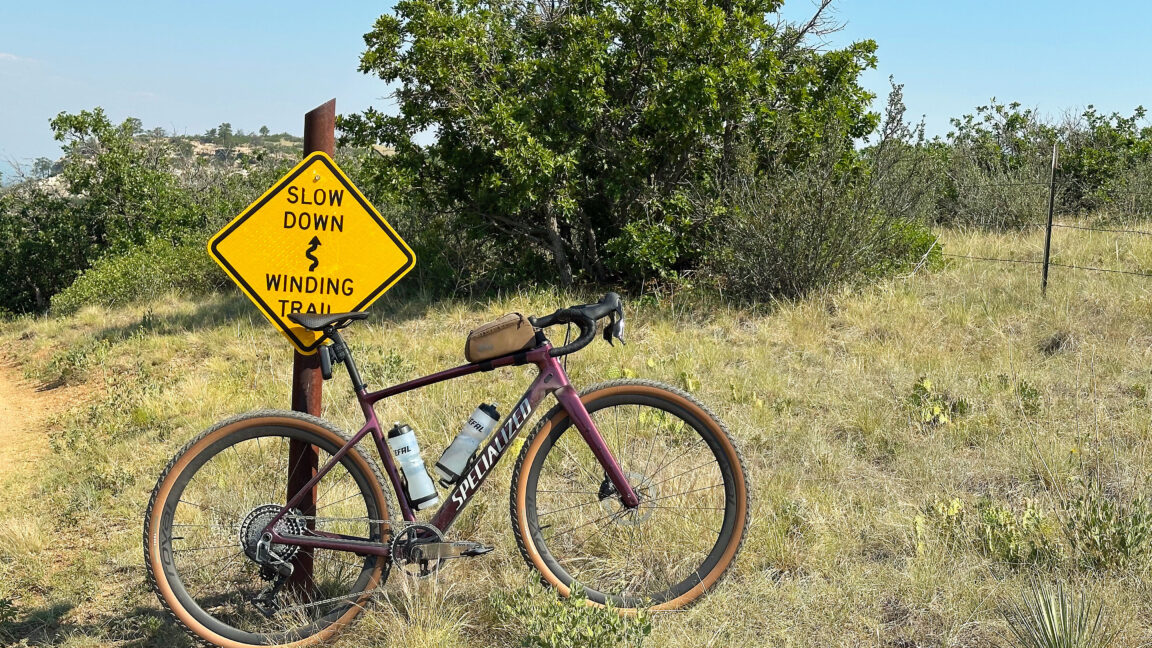
When I make my yearly trip to Denver, I always bring my road bike. It’s my annual chance to suffer on the kinds of gradients unavailable in the glacier-scoured lands of northeastern Illinois. In advance of this year’s trip, Specialized hooked me up with its new gravel bike, the Diverge Pro 4, so I brought it with me to challenge it in ways not possible on the fastidiously groomed gravel trails of suburban Chicago.
In contrast to the Specialized Turbo Creo 2 we reviewed a couple of years ago, the Diverge Pro 4 is strictly human-powered. Specialized calls it “the ultimate getaway vehicle,” designed with input from off-road adventure riders, scientists, and racers. It’s marketed as the only gravel bike you need for racing, adventure, and distance rides.
While I can’t speak to its racing performance, I can say the Diverge Pro 4 is a blast on any kind of gravel and does well enough on the road. Priced at $8,249, the Diverge Pro 4 is designed for rough trails and technical descents, both of which unfolded below me at the summit of an is-it-gravel-or-is-it-single-track climb in Douglas County, Colorado. I took a deep breath, and down I went.
The descent was rutted and slightly more technical than anything I’ll ever run into around Chicago, but I had enough time on the bike to realize that if I had trouble on the descent, it wouldn’t be the bike’s fault. To understand what makes the Diverge Pro 4 stand out, I’ll start with my favorite feature. Future Shock 3.3 is Specialized’s suspension system, and it’s a significant upgrade over the earlier versions used on the Turbo Creo 2 and Diverge Pro 3.
The mechanism lives between the head tube and stem. It isolates the rider from high-frequency impacts while adding relatively little weight and without changing the bike’s steering geometry or introducing brake dive—two compromises that can come with conventional suspension forks. The fork, head tube, and front wheel remain rigidly connected, with the stem and handlebars moving vertically relative to the rest of the bike.
Extract — continue reading at the source.