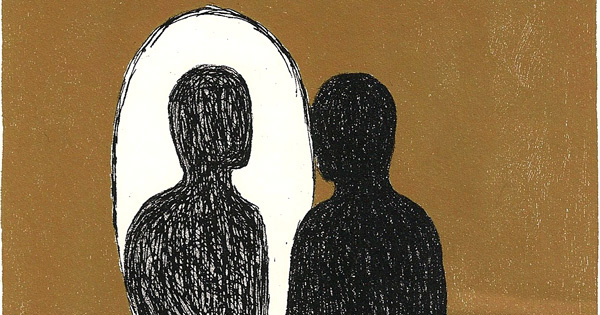
To be a true person is to be entirely oneself in every circumstance, with all the courage and vulnerability this requires. And yet because a person is a confederacy of parts often at odds and sometimes at war with each other, being true is not a pledge to be a paragon of cohesion, predictable and perfectly self-consistent — the impossibility of that is the price of our complex consciousness — but a promise to own every part of yourself, even those that challenge your preferred self-image and falsify the story you tell yourself about who you are. There is a peace that comes from this, solid as bedrock and soft as owl down, which renders life truer and therefore more alive.
Such authenticity of aliveness, such fidelity to the tessellated wholeness of your personhood, may be the crux of what we call “the good life.” That is what the pioneering psychologist Carl R. Rogers (January 8, 1902–February 4, 1987) explores in a chapter of his 1961 classic On Becoming a Person (public library), anchored in his insistence that “the basic nature of the human being, when functioning freely, is constructive and trustworthy” — a bold defiance of the religious model of original sin and a cornerstone of the entire field of humanistic psychology that Rogers pioneered, lush with insight into the essence of personal growth and creativity. Drawing on a lifetime of working with patients — the work of guiding people along the trajectory from suffering to flourishing — he writes: The good life… is the process of movement in a direction which the human organism selects when it is inwardly free to move in any direction, and the general qualities of this selected direction appear to have a certain universality.
He identifies three pillars of this process: In the first place, the process seems to involve an increasing openness to experience… the polar opposite of defensiveness. Defensiveness [is] the organism’s response to experiences which are perceived or anticipated as threatening, as incongruent with the individual’s existing picture of himself, or of himself in relationship to the world. These threatening experiences are temporarily rendered harmless by being distorted in awareness, or being denied to awareness.
I quite literally cannot see, with accuracy, those experiences, feelings, reactions in myself which are significantly at variance with the picture of myself which I already possess. The necessary illusions Oliver Sacks wrote of are a form of that defensiveness — they help us bear the disillusionments difficult to bear: that we are invulnerable, immortal, congruent with our self-image — and yet they render us captives of the dream of ourselves, unfree to live the reality of our own complexity. Rogers writes: If a person could be fully open to his experience, however, every stimulus — whether originating within the organism or in the environment — would be freely relayed through the nervous system without being distorted by any defensive mechanism.
There would be no need of the mechanism of “subception” whereby the organism is forewarned of any experience threatening to the self. On the contrary, whether the stimulus was the impact of a configuration of form, color, or sound in the environment on the sensory nerves, or a memory trace from the past, or a visceral sensation of fear or pleasure or disgust, the person would be “living” it, would have it completely available to awareness. The reward of this willingness to be fully aware is profound self-trust: The individual is becoming more able to listen to himself, to experience what is going on within himself.
He is more open to his feelings of fear and discouragement and pain. He is also more open to his feelings of courage, and tenderness, and awe. He is free to live his feelings subjectively, as they exist in him, and also free to be aware of these feelings.
Extract — continue reading at the source.