The very fact that life surprises us is evidence that it can surprise us, that it will surprise us over and over. To mistake our theories of probability for a realistic representation of possibility is to forget that the improbable gave us all we know of existence. And yet precisely because the future is a garden of infinitely forking paths in which any outcome is possible, we yearn to know the direction our lives will take.
This is absolutely and categorically impossible. We may, of course, have expectations and beliefs about what is likely to happen. But they are simply imaginative stories to which reality bears no obligation, stories negating the fundamental fact that the imagination of life is always greater than that of the living.
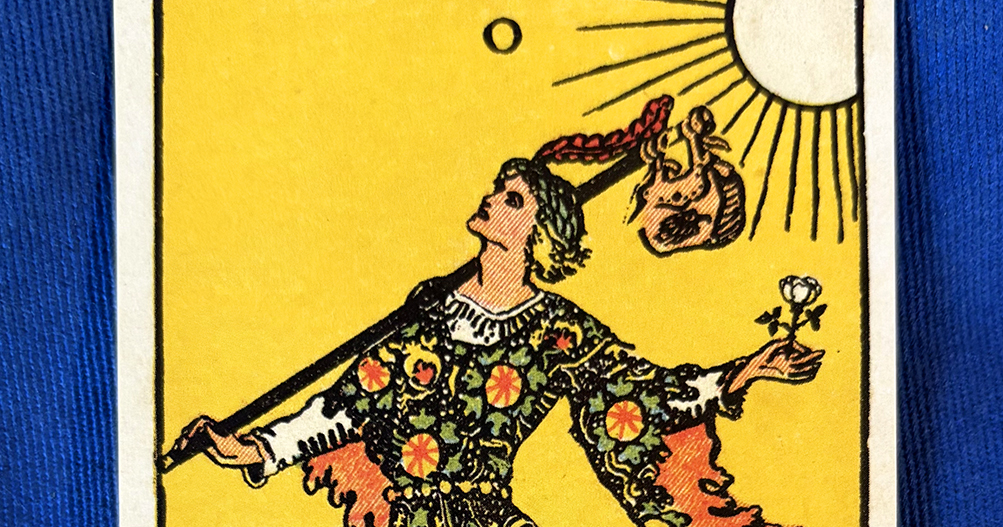
Because we cannot bear this indeterminacy, we have been inventing technologies of divination since ancient times. But while they may be futile in foretelling the future, they are not useless — their misunderstood gift is that they tell us back to ourselves, revealing regions of our psyche over which our conscious thought casts an impenetrable shadow, giving us a tuning fork for the purest note of the inner voice. (This, of course, is the concept of the bird divinations.) D.H. Lawrence knew this when he observed that divination is really just an annealing of attention and that “an act of pure attention, if you are capable of it, will bring its own answer.” Chilean-French filmmaker Alejandro Jodorowsky articulates this beautifully in The Way of Tarot (public library) — his insightful exploration of one of our oldest and most enduring divination technologies not as a predictive mechanism but as a spiritual path.
Declaring himself “absolutely opposed to reading hypothetical futures,” and “repulsed” by the notion that we are prisoners of destiny — a notion that began in the Greek theater of antiquity and was replicated in the determinism of twentieth-century physics — he writes: If, from the moment we are born, a god is directing every step we take, what is the good of striving for anything at all? Should we believe that our life is inevitably laid out in advance and all we are allowed to do is submit? To confront the idea of reading the cards, I had to define my notion of future.
The reading subject either has or does not have a purpose in his life; he acts in accordance with projects, and he makes plans. When he starts worrying about knowing his future, he is depreciating his present actions, which he doubts. But the present is a fleeting instant: what weighs upon the development of the person receiving the reading is the past, which can act like ballast that tends to cause the future repetition of traumatic experiences from childhood (I will either do or not do what others have done or did not do to me), or as a source of energy that pushes us to progress, to change — in the best cases, transform ourselves.
If I have to accept the existence of a preordained future, I would visualize the present as a point from which a fan of infinite paths departs. An intentional action or an accident, something that happens by chance, projects us forward and obliges us to live one of the countless fates possible. This would allow me to declare, even when “everything has been written,” that the divine menu does not consist of a single dish but a huge selection.
Extract — continue reading at the source.