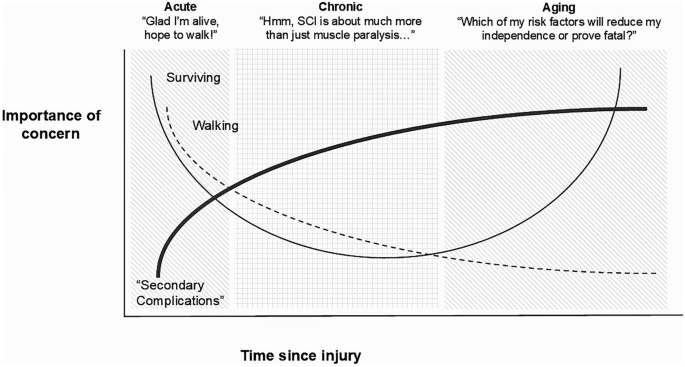
Spinal cord injury (SCI) carries one of the highest disability weights among conditions tracked in the WHO’s Global Burden of Disease framework, yet federal research investment remains skewed toward locomotor restoration rather than the secondary complications—bowel and bladder dysfunction, autonomic dysreflexia, pressure injuries, and neuropathic pain—that people with chronic SCI consistently identify as their greatest daily burden. Drawing on patient perspectives, a systematic funding analysis, and two decades of survey data, this piece shows that SCI receives approximately 0.2% of NIH funding against roughly 1% of U.S. disease burden, and that within SCI research itself, movement/mobility studies (2017–2023) drew nearly twice the funding allocated to pain, bladder, bowel, and pressure-injury research combined. This misalignment persists despite a 2004 survey establishing that the functional priorities of people living with SCI diverge sharply from prevailing research goals.
Secondary complications are argued to warrant treatment as primary research targets rather than downstream concerns, alongside compounding structural barriers: a shortage of trained SCI physiatrists, underpowered and poorly reproducible preclinical models, and inconsistent translation of lived-experience data into funding decisions. Researchers, clinicians, and advocates are called upon to realign scientific priorities, clinical training, and policy with the actual burden of chronic SCI, closing a gap that has persisted largely unaddressed for over twenty years. Marco Sorani has lived with a complete cervical (C6) spinal cord injury (SCI) for 32 years, enduring autonomic dysreflexia, painful bladder-related headaches, hospitalizations for heat exhaustion and urinary tract infections, rotator cuff tears, and shoulder/elbow pain.
Early spasticity nearly threw him from his chair; as it subsided, muscle atrophy and leg edema increased, along with osteoporosis, yearly falls, lost toenails, and scoliosis. His greatest complication has been periodic bowel incontinence and constipation and the toll they exact on travel, work and peace of mind. Sasha Rabchevsky has lived with a complete thoracic (T5) SCI for 40 years, studying the secondary consequences of paralysis, notably arguing that autonomic dysreflexia warrants research priorities comparable to locomotor recovery.
His recent case history includes a septic stage-4 sacral pressure wound, renal dysfunction, a colostomy for fecal incontinence, pancreatic tumors requiring a Whipple procedure, and MRSA infection of his 2002 abdominal stimulator implant, spreading to its eight leads in his legs and backside. This required eight months of repeated out-of-state travel for staged surgical removal of each infected electrode, followed by final decubitus repair by an out-of-network provider. While such experiences are anecdotal, collectively they mirror functional priorities identified in SCI patient preference studies.
Most researchers are not unaware that people with SCI struggle with unpredictable bowel and bladder routines and many other conditions. But while scientific peers acknowledge the gap between lived reality and bench-side SCI studies, most remain predominantly focused on their chosen research models, offering clinical relevance only in the abstract. There is rationale for continued investment in locomotor restoration to increase mobility and independence, as well as cardiovascular and respiratory health, muscle mass and bone density.
In addition, clinical studies report that neuromodulation interventions often improve autonomic function simultaneously, if not exclusively. Although substantial research efforts have targeted bowel, bladder, cardiovascular, autonomic, and pain outcome measures, current funding distributions do not fully reflect the burden of these complications experienced by individuals living with chronic SCI. We posit that secondary conditions should be regarded as primary research targets, studied as equitably as restoring the ability to locomote after SCI.
Extract — continue reading at the source.