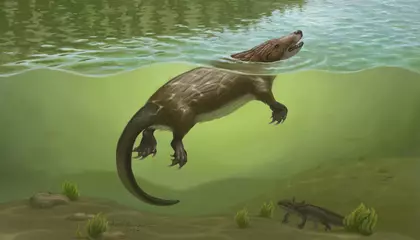
Some 165 million years ago, a predator that looked like a strange mishmash of a platypus and river otter roamed what’s now China. And surprisingly, the now-extinct “chimera” already had certain throat features that define today’s living mammals—even though it wasn’t a true mammal. A well-preserved fossil of the odd creature reveals it could suckle its mother’s milk, researchers report in a study published October 7 in the journal Nature.
The specimen represents a previously unknown genus and species, and it’s the earliest known example of a semi-aquatic mammal-like animal. The animal is estimated to have been around 16 to 20 inches long and weighed roughly 2 to 4.5 pounds. It was a docodont, a member of an extinct group of close relatives to mammals dating back to the Mesozoic Era, some 66 million to 252 million years ago.
Researchers named its genus Megacauda in reference to its wide tail and its species sungei in honor of paleontologist Sun Ge. Digital reconstructions based on CT scans revealed M. sungei had a shockingly modern throat structure. The sharp-toothed creature had small bony projections on the roof of the mouth, which, in modern mammals like humans, support the soft palate.
This tissue structure separates the oral cavity from the throat, allowing suckling, swallowing and breathing. What’s more, the researchers found hyoid bones in the throat, which anchor certain muscles and help today’s mammals swallow without the aid of gravity. The structures suggest M. sungei could chew bits of food and swallow one morsel at a time, rather than shaking its head to jiggle large hunks of food down its throat like a crocodile, according to a statement.
Scientists suspect that this evolutionary adaptation allowed mammal species to develop a variety of diets and become carnivores, insectivores, omnivores or herbivores. The findings also hint that a young animal could suckle its mom’s milk without the liquid entering its nose, a trait that “literally defined our biology,” study co-author Zhe-Xi Luo, a paleontologist at the University of Chicago, tells NPR. We’re named after the mammary glands,” or milk-producing structures.
The animal may have navigated its watery environment by using its front legs to paddle, swishing its tail in a wave-like motion and using its hind legs to steer. The fossil represents the earliest evidence of a mammal conducting a partially aquatic lifestyle, study co-author Thomas Martin, a paleontologist at the University of Bonn in Germany, says in a separate statement. The findings suggest that swimming evolved early in the mammal lineage, Luo tells the Australian Broadcasting Corporation’s Peter de Kruijff.
Extract — continue reading at the source.