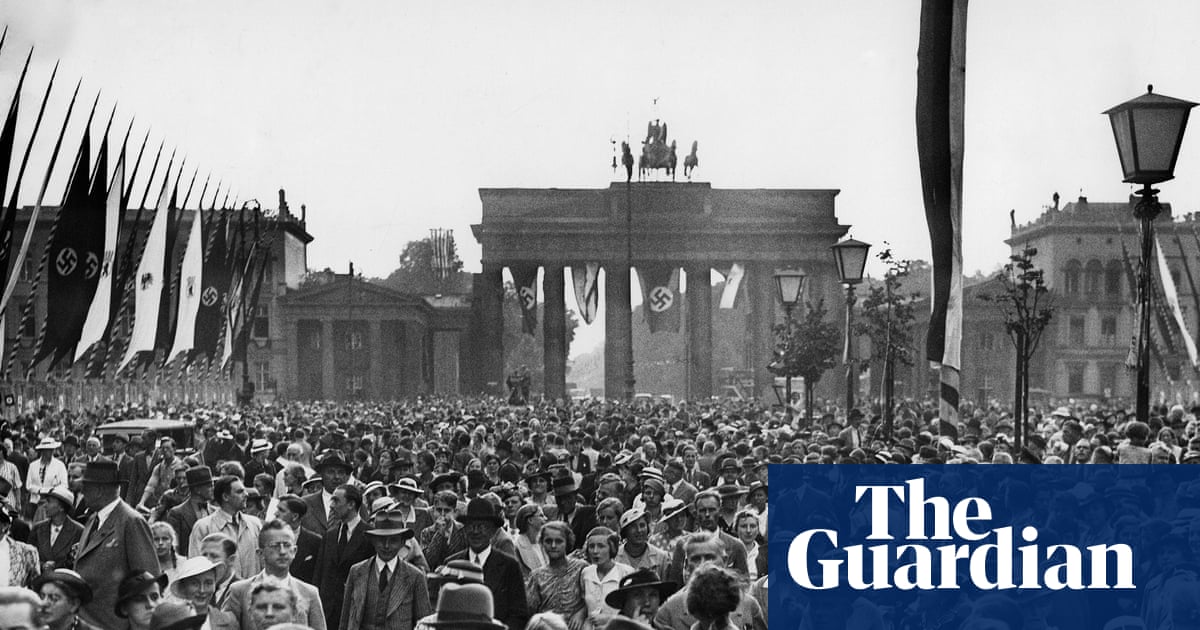
War was not yet on the immediate horizon when Samuel Beckett visited the German city of Hamburg in October 1936, but after watching the apoplexy that Adolf Hitler’s braying induced in ordinary Germans, the Irish playwright was certain that peace could not last. The six notebooks that Beckett compiled during his six-month journey across Germany between late September 1936 and April 1937, published for the first time by German publisher Suhrkamp on 20 August this year, put paid to a commonly held view of the author of Waiting for Godot as a poet of pure pessimism, interested in despair and stasis but unconcerned by real-life politics. On the basis of letters and diary extracts, critics of the past concluded that the 1969 Nobel Prize winner travelled across Germany in a state of self-absorption, without paying attention to the rise of totalitarianism.
But the notebooks in their entirety show that Beckett was studying National Socialist resentment in close detail. He noticed changes in fashion, such as the predominance of the “Hitler coat”, and collected the “holy phrases” of the Nazi movement in lists: Führer (“leader”), Bewegung (“movement”), Blut und Boden (“blood and soil”), and Freiheit und Ehre (“freedom and honour”), even if they repulsed him. Ihre Kraft durch Freude Unterhaltung macht mich fertig, he noted in German on 1 November 1936: “Their Strength Through Joy conversation is killing me.” For now Beckett, who would join the French resistance in 1940, kept his disgust mostly private, merely taking pleasure in subtle parodies of totalitarian behaviour, by “(sticking) the wrong arm out” when invited to give the Nazi salute.
Maybe he could have been more explicit had this danger not hung over him. But they do clearly form a rebellion against Nazi rationalising discourse.” Beckett’s tour of some 30 German towns and cities, including Hamburg, Berlin, Dresden and Munich, was motivated by a desire to view works of art and to improve his language skills. An interest in German – his third language after English and French – was probably influenced by lengthy visits between 1928 and 1932 to his cousin and sweetheart Peggy Sinclair and her family, who lived in Kassel.
The curiosity about German language and culture was reminiscent of the American English writer Christopher Isherwood, who, asked how he documented Germany between 1929 and 1933, said: “I am a camera with its shutter open, quite passive, recording not thinking.” Beckett’s observed the country’s descent into totalitarianism in an already depressed state of mind. Peggy had died in Germany of tuberculosis in May 1933, his father of a heart attack the following month. The remaining Sinclairs, of Jewish descent, had been forced to flee Germany in 1936.
By the time he set out for Cuxhaven, Beckett had two years of psychoanalysis behind him, and his diaries reflect deep anguish, psychosomatic complaints, medical ailments, bodily functions, financial woes and angst over his writer’s block. At times, it is hard to separate his own problems from the darkening political situation around him. Bald fange ich wirklich an zu kotzen.
Oder fahr heim (“soon I’ll really start to puke. Or I’ll go home”) he writes on 15 January, 1937. In the diaries he keeps telling himself to be more minimal, which is the Beckett we know, who strips everything away that doesn’t matter.” The writer’s subsequent move to France and involvement with the French resistance can be seen as a reaction to what he witnessed in Nazi Germany, Nixon believes.
Extract — continue reading at the source.