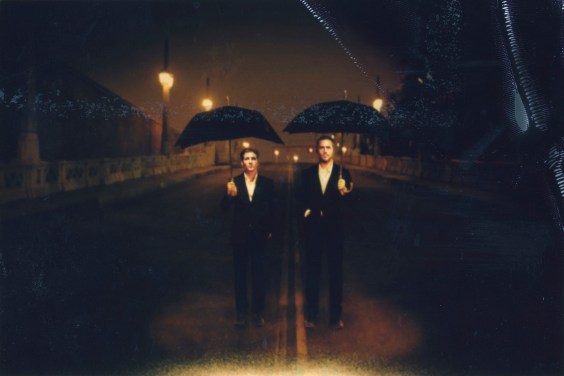
On a darkened rooftop in Tel Aviv, Israeli intelligence officers outline the details of their work. These men tell us how they helped develop an AI mapping tool that trawled for phone signals and recommended apartment buildings in Gaza to bomb. Indirectly, they admit, they are responsible for thousands of deaths, but they never spoke up because that wasn’t their place.
NAZA – directed by the Israeli film-makers Rachel Szor and Yuval Abraham and produced by the Guardian – is a chilling documentary about a mass slaughter that was authorised at the highest levels of government. But it is also, primarily, about the process, the system, the little links in the killing chain. Szor and Abraham build their film around the accounts of 24 anonymised military and intelligence insiders.
NAZA, we learn, is an acronym used by the intelligence service to indicate how many civilians it expects to die in an airstrike on Gaza. The Israel Defense Forces prefer to target Hamas terrorists in their homes at night – and if they live with their family, or in heavily populated neighbourhoods, too bad. At one point, a source claims, approval was given to kill 500 NAZA for one Hamas member.
I meet Szor and Abraham at the Venice film festival, where NAZA is competing for the Golden Lion award. The pair won an Oscar for their previous documentary, 2024’s No Other Land (co-directed with Basel Adra and Hamdan Ballal), which spotlighted Palestinian resistance in the occupied West Bank. It’s not a coincidence that this film is all in the dark.
We are in a very dark place right now.” The Gaza health ministry has reported more than 73,000 deaths in three years of Israeli bombardment, the vast majority of which have been civilian casualties. NAZA briefly shows us the rubble, grieving parents, dead children on the ground. Its main backdrop, though, is placid, normal Tel Aviv, just 44 miles to the north, where rush-hour traffic drifts dreamily on the street and the cinematheque is showing a Claude Lanzmann retrospective.
Tellingly, the film was executive produced by Jonathan Glazer, the director of The Zone of Interest. It was Glazer, says Szor, who advised on the structure and creative approach, fostering the sense of a home that sits next door to a hell. NAZA deliberately concerns itself with the system – the policy of mass surveillance, the industrial business of murder – more than the individual psychology of those involved.
Extract — continue reading at the source.