The outer solar system is yielding its secrets to the Vera C. Less than five months into the observatory’s decade-long survey of the sky, a potential new dwarf planet has already popped up in its data, astronomers reported this week at a meeting of the American Astronomical Society’s Division of Planetary Sciences in Spokane, Wash. Another team reported a handful of new Neptune Trojans, icy objects that share an orbit with Neptune, at the meeting and in the Astrophysical Journal Letters.
The findings are filling in astronomers’ picture of the Kuiper Belt at the solar system’s frigid fringes. The observatory took its first images in June 2025 and officially began a decade-long survey in June 2026. Even before the official survey started, Rubin had detected the motion of an object orbiting billions of kilometers beyond Pluto.
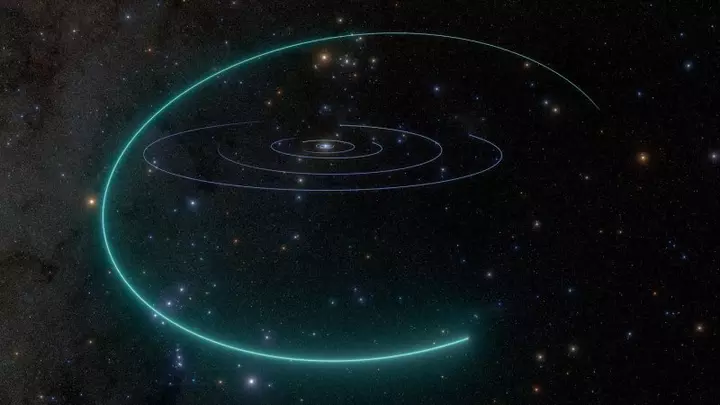
Rubin observed the object 30 times on 20 nights between March 4 and July 11. But no one knew it was there until October 13, when astrophysicist Matt Holman of the Smithsonian Astronomical Observatory in Cambridge, Mass. ran a search for moving dots of light in the data. The object, called 2026 ED138, appeared to be about 47 times as far from Earth as Earth is from the sun.
Its brightness suggests it’s between 600 and 1500 kilometers wide, potentially as large as other dwarf planets like Ceres and Makemake. That’s probably big enough to be spherical, making it a dwarf planet. It’s damn huge,” Deen says.
Deen was able to trace it back even farther, to photographic plates taken as part of a sky survey at Palomar Observatory in California in 1954. Other amateur astronomers independently found the same sightings. If you know it’s supposed to be there, it’s not particularly faint.” So why didn’t anybody notice it until now?
It’s partly because ED138 practically crawls across the sky, orbiting the sun once every 280 years. It was also moving against a dense background of Milky Way stars, where it blended in. By combining observations spanning decades, astronomers can calculate the object’s orbit with more precision.
Extract — continue reading at the source.