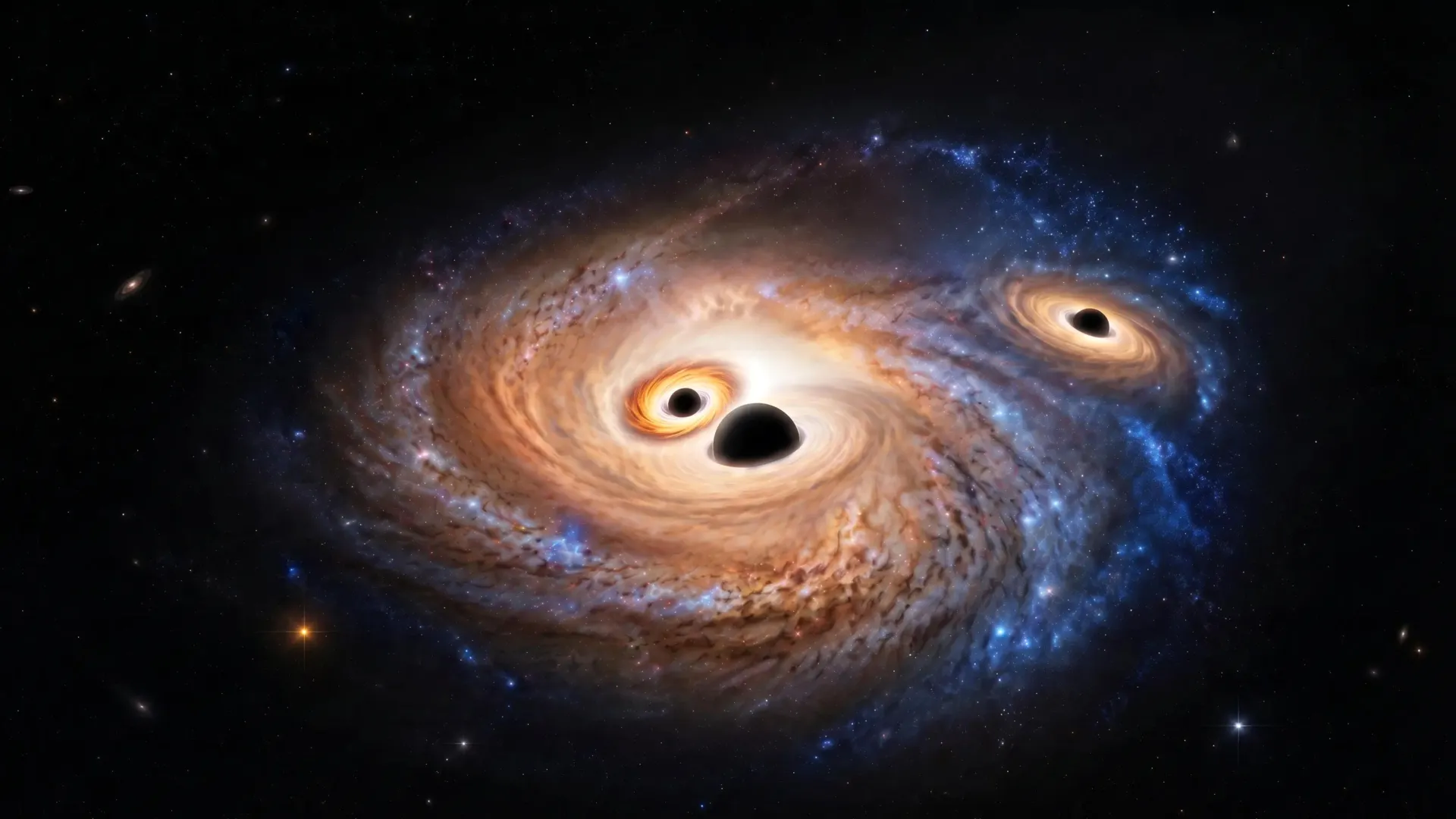
Astronomers have discovered three actively feeding supermassive black holes in a single galaxy more than 12.5 billion light-years from Earth. The finding, made by an international research team led by the Max Planck Institute for Extraterrestrial Physics (MPE), offers a rare glimpse of how enormous black holes grew and interacted during the universe's earliest stages. The black holes are located in a galaxy known as J0148-4214.
All three are actively accumulating matter, which spirals toward them through surrounding disks of gas and other material. Because the galaxy is so distant, its light has traveled through space for approximately 12.5 billion years before reaching Earth. This means astronomers are observing it as it existed just 1.2 billion years after the Big Bang.
Over such vast distances, the expansion of the universe stretches light to longer, redder wavelengths. Astronomers measure this effect through a property called redshift. For J0148-4214, the researchers measured a redshift of z=5.02, allowing them to determine its remarkable distance.
"This is the first evidence of three active black holes in a single galaxy in the distant Universe," says Hannah Übler, research group leader at MPE and lead author of the study. Two of the black holes lie near the galaxy's center, separated by a projected distance of just 620 light-years. The third is much farther out, approximately 5,500 light-years from the center.
The discovery provides important evidence about how massive black holes came together in the young universe. "It suggests that processes in the early Universe were efficient at bringing massive black holes together, setting the stage for the massive black hole mergers we expect to detect with future gravitational wave observatories," says Übler. Astronomers believe that galaxy collisions and mergers were common during the universe's early history.
As galaxies combined, their central black holes could also move closer together and eventually merge. These mergers would produce increasingly massive black holes at the centers of the newly formed galaxies, potentially helping explain how some grew to enormous sizes so soon after the Big Bang. How Astronomers Detected the Hidden Black Holes The researchers identified the three black holes by examining distinctive patterns in the light emitted by hydrogen gas.
Extract — continue reading at the source.