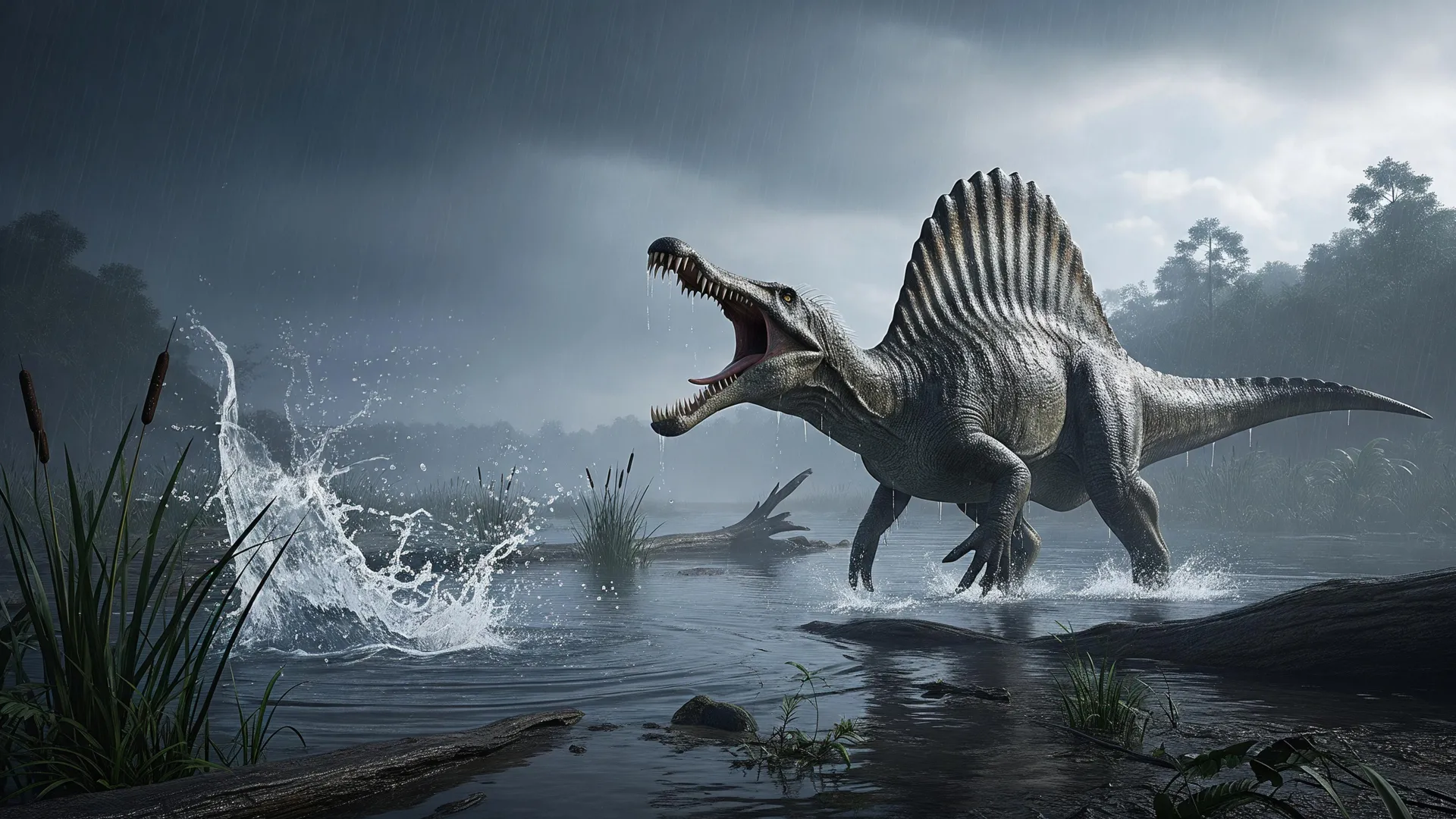
For millions of years, evolution helped animals make the transition from life in the ocean to life on land. But the journey did not always move in one direction. Many species eventually returned to the water, developing new adaptations that allowed them to thrive in aquatic environments.
Dozens of major groups of mammals and reptiles made this remarkable evolutionary reversal. Now, a new study from Yale University is shedding light on when and how these transitions occurred, as well as which ancient animals became fully aquatic and which continued to depend on land. The findings were published in the journal Current Biology.
"These secondarily aquatic groups adapted in strikingly similar ways to their new aquatic home -- evolving flippers and a suite of other features that made them better swimmers," said lead author Caleb Gordon, who completed his doctorate at Yale's Graduate School of Arts and Sciences (GSAS) earlier this year and is now a postdoctoral researcher at the Florida Museum of Natural History. "As a result, they've become textbook examples of convergent evolution, which can tell us a lot about the processes driving and constraining adaptive change in response to similar environmental cues." Using Ancient Fossils and AI to Reconstruct Evolution To investigate these evolutionary changes, the researchers examined hundreds of fossil and modern specimens housed at the Yale Peabody Museum and dozens of other institutions worldwide. They collected extensive new data, including measurements (more than 11,000), photographs, and CT scans.
The team combined traditional paleontological techniques with machine learning models that account for evolutionary relationships. They also incorporated a statistical approach originally used by naval forces during World War II. Together, these methods offered a new way to investigate one of the most remarkable transitions in vertebrate evolution.
"Reconstructing the lives of extinct life forms in a scientifically rigorous way, as opposed to just telling stories, is a precise and delicate undertaking," said Bhart-Anjan Bhullar, senior author of the study. Bhullar is an associate professor of Earth and planetary sciences in Yale's Faculty of Arts and Sciences (FAS) and an associate curator of vertebrate paleontology and vertebrate zoology at the Peabody Museum. "It requires a careful interweaving of data from modern organisms, of which our understanding is necessarily far deeper, and knowledge of these living organisms' genealogy relative to fossil forms," he said.
"Caleb's work accomplishes all of this and more, and on a massive evolutionary scale." For decades, scientists have disagreed about when particular groups of prehistoric animals became fully adapted to life underwater. The fossil record often provides incomplete or conflicting clues, making it difficult to determine whether an extinct species primarily lived on land, in water, or in both environments. Some skeletal features may indicate an aquatic lifestyle, while others suggest that the same animal remained capable of moving and feeding on land.
Extract — continue reading at the source.