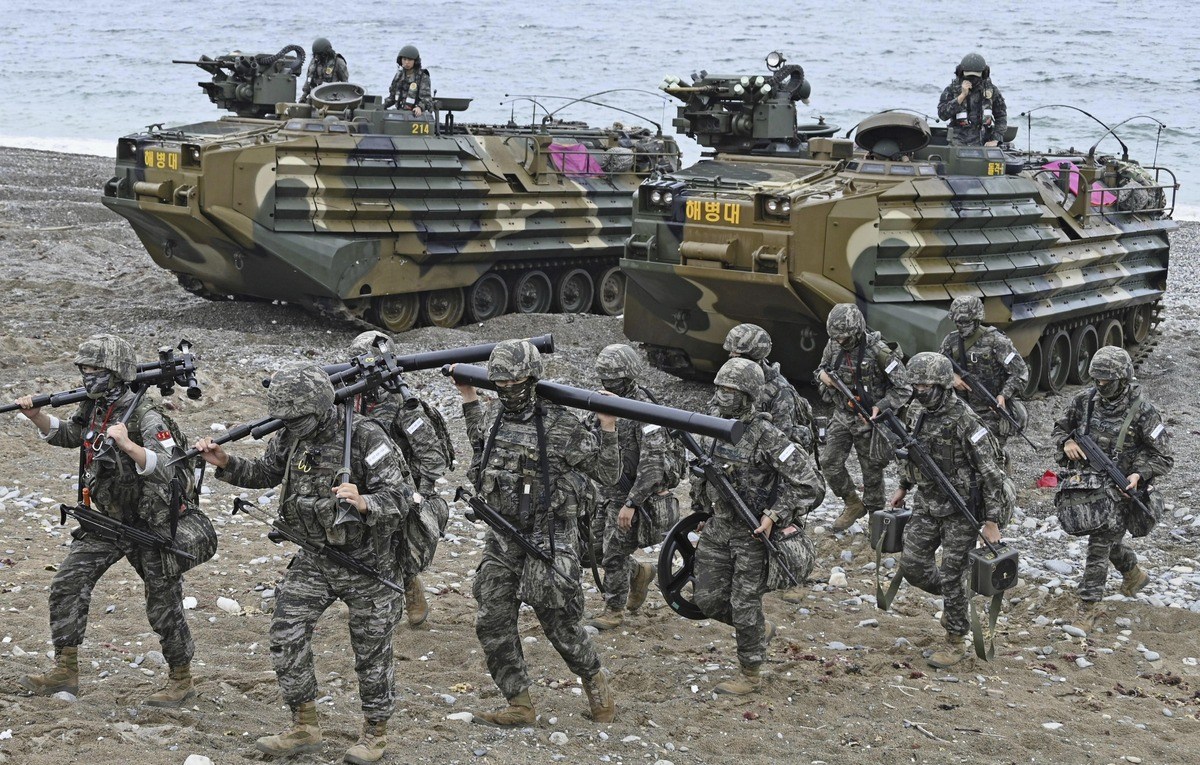
The Trump administration cut joint Marine drills with South Korea planned for next month, Seoul's military has said, in the latest show of the strain the months of war with Iran have put on the U.S. military. The United States, which deployed thousands of Marines to the Middle East for its conflict with Tehran, told South Korea in June it wouldn't have enough forces available to join this year's Exercise Ssang Yong, a spokesperson for Seoul's Marines told reporters on Monday. The U.S. and South Korea are discussing resuming the drills in the future, South Korean Marine Corps public affairs chief Han Seung-jeon said.
Ssang Yong, meaning "twin dragons," typically simulates joint U.S.-South Korean forces rushing to shore from amphibious ships and attacking an enemy on land. The United Kingdom's Commando Force has joined the drills in recent years. But the little under six months of war between the U.S. and Iran has raised questions about whether even a military as powerful as the U.S.'s, backed by the highest defense spending in the world, can maintain its presence across the world while fighting a conflict with no apparent end.
The U.S. government has said the military can perform any mission required of it, downplaying concerns about how quickly its forces have burned through advanced, hard-to-replace missile stocks. The Pentagon referred queries to U.S. Marine Forces Pacific, which Newsweek has contacted for comment.
An estimated 50,000 U.S. troops were deployed to the Middle East at the height of U.S. operations, including several thousand Marines with the 31st Marine Expeditionary Unit (MEU) and the 11th MEU. The 31st MEU returned to Okinawa, Japan, last month, while the 11th MEU was still in the Middle East in early August, according to Pentagon images. The last remaining U.S. aircraft carrier deployed in Asia, the USS George Washington, arrived in the Middle East last week to take over from the tired crew on the USS Abraham Lincoln, amid concerns that they were suffering mental health crises and shortages of vital supplies after their deployment was repeatedly extended.
The war against Iran came off the back of an extensive military build-up in the Caribbean, U.S. operations to capture former Venezuelan President Nicolás Maduro and a strike campaign on suspected drug-smuggling boats in the eastern Pacific and Caribbean Sea that U.S. officials say have killed more than 200 people. Southern Command (SOUTHCOM) said on Monday it had struck a vessel in the eastern Pacific the previous day, killing two "narco-terrorists." This appears to be the first attack on alleged narcotrafficking boats in more than two months. Defense Secretary Pete Hegseth said this month Colombia, Guatemala, Honduras and Ecuador had greenlit joint U.S. military operations against criminal organizations on their soil, further expanding the potential for U.S. military involvement abroad.
President Donald Trump abruptly scaled back scheduled military drills with South Korea just hours before the exercises kicked off in mid-August. The annual joint exercises "send a signal that is totally inappropriate and hostile" to North Korea, Trump said, a remark widely seen as an olive branch to Pyongyang—although Trump also framed the pullback as punishment for what he cast as Seoul's refusal to become embroiled in the Iran war. North Korea had railed against the drills, dubbed Ulchi Freedom Shield, calling the exercises a rehearsal for war.
Extract — continue reading at the source.