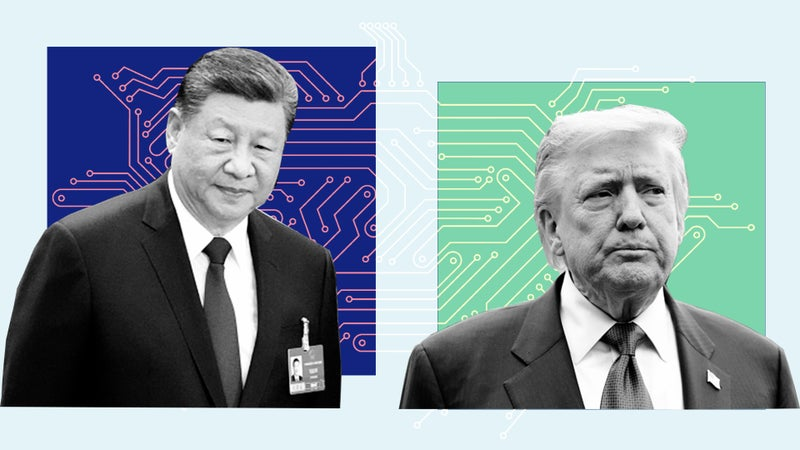
On the eve of the September 24 meeting between Donald Trump and Xi Jinping, representatives of both sides sat down for a closed-door "technical" session. On the American side were Treasury Secretary Scott Bessent and Trade Representative Jamieson Greer, and on the Chinese side, Vice Premier of the State Council He Lifeng. Their goal was to find common ground on the issues that matter most, namely the trade imbalance, artificial intelligence, and rare earth elements and critical minerals.
And while this meeting carries obvious weight for the two countries themselves, given the geopolitical stature of those at the table and the sharp rhetoric of the ongoing trade wars, its consequences reach far beyond Washington and Beijing. The rest of the world has a stake in how this plays out. Let's start with a simple observation.
China is already beginning to overtake the United States in a number of industries, take electric vehicles and batteries for instance. Companies like BYD haven't merely caught up. By sales volume they have already pulled ahead of Tesla, while the battery giant CATL commands the lion's share of the global lithium-battery market.
While Detroit is still slowly warming up to the shift toward electric drivetrains, Chinese factories are churning out affordable models that sell briskly at home, across Asia and Latin America, and are pushing ever more aggressively into Europe. The same story is unfolding in solar power. More than 80% of all solar panels in the world are made in China today, from silicon wafers to finished modules.
American manufacturers simply cannot keep pace in the price race, and even tariffs do little to change the picture. Whoever controls panel production largely sets the tone for the entire planet's green transition. It is now clear that the United States has no intention of running this race alone.
Washington is betting on its allies - first and foremost Japan and South Korea, two countries that are technological heavyweights in their own right. The logic is straightforward: if catching up with China's sheer scale single-handedly has become all but impossible, then pooling resources, patents, and manufacturing capacity collectively evens the odds. As one example, in response to the growing alignment between Russia and China on Arctic affairs, the United States, Japan, and South Korea intend to build a framework for cooperation in the Arctic covering navigation and mineral extraction.
Extract — continue reading at the source.