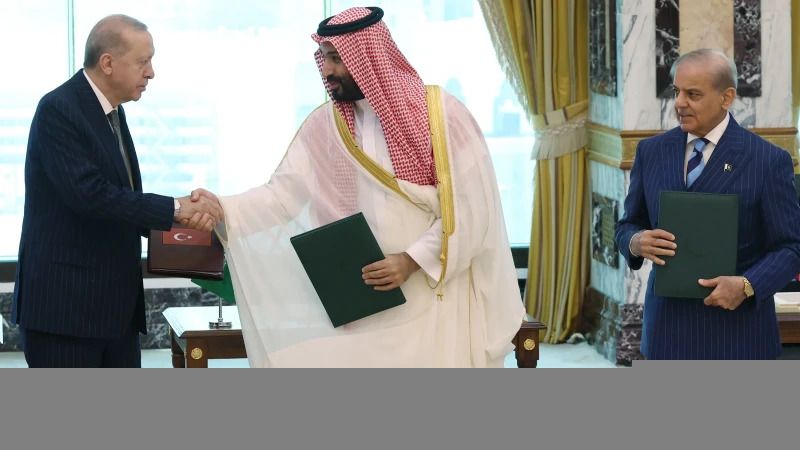
I place considerable emphasis on the geopolitics of the triangle because it is the most concrete indication that the theoretical framework concerning the region’s future and scope has moved beyond theory and been translated into practice. The Türkiye-Pakistan-Saudi Arabia alliance is a step that goes beyond the policies of its current and prospective members and opens a broader channel extending from West Asia and the Caspian to Central Asia and, ultimately, the wider world. We first demonstrated the extent of its reach by examining its implications for India (“Why Did the US Call India the Day After the Mecca Agreement?”, 19/08).
There are now many views that one dimension of the US-China rivalry, which has been brought into the ring for the final reckoning over the emerging order, is this pact. If that is the case, then the question must be asked: “What does China have to say about this pact?” It would hardly be possible to argue that Beijing has failed to notice such a development. China has extensive regional interests in the Gulf and Iran, considers countries such as Afghanistan and India strategic priorities, attaches enormous importance to Pakistan, and has made massive economic and political investments through initiatives such as the Belt and Road Initiative.
Even where energy resources are concerned, Beijing considers it vital not necessarily to own them, but to control who controls the routes and access to them. Of course, the Chinese have noticed. They have even taken a position.
China’s perception of the Mecca Agreement may surprise you. Put in the simplest terms, they see it as a clear manifestation of the growing weakness of US power. How can a pact supported by the West, described as a “good thing” by the US president himself, and one whose ultimate target is said to be China, while also extending into areas where Beijing has clear strategic interests, be viewed positively by China?
First, let us understand this issue of “weakness” that the Chinese are talking about. The Iran war could serve as an example in itself, and a sufficient one at that, because, as we have repeatedly argued, the United States has been defeated and has become entangled in trying to figure out how to extricate itself from the situation. But we now have an example from the front line itself: North Korea and South Korea.
US initiatives to reduce its military presence in South Korea, cut defense spending there, suspend joint military exercises, and demand $10 billion annually to cover the costs of its presence had such an impact in Seoul that South Korean officials hurriedly held talks with China. This does not, of course, mean that Seoul’s policies have undergone a dramatic transformation. But it is clear that Washington’s unexpected moves have caught South Korea off guard.
Extract — continue reading at the source.