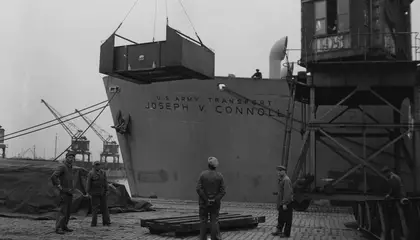
Connolly was one of 2,742 Liberty ships built during World War II. At 441.5 feet long and 57 feet wide at the beam, these cavernous vessels could haul 10,800 tons of whatever the United States Army required: ammunition, jeeps, tanks and even locomotives. Immense, rough-edged and clunky, the Liberty class wasn’t known for its looks.
Roosevelt even called the vessel “a real ugly duckling.” But on the morning of October 26, 1947, as it rolled in the swells just outside of New York Harbor, the Connolly was anything but ugly. Wreaths and garlands of laurel leaves draped the vessel’s bridge as its American flag snapped in the wind at half-mast. During the previous week at sea, the Connolly’s crew had slapped on a fresh coat of gray paint.
Bostelman guided his ship into port, U.S. Navy destroyers Beatty and Bristol swung into position ahead, their crews strewing flowers on the Connolly’s path. Meanwhile, a squadron of fighter planes joined the flotilla of police and fireboats in what the New York Times called a “marine escort of honor.” As the Connolly churned past Brooklyn and into Upper New York Bay, artillery pieces at Forts Hamilton, Wadsworth and Jay fired off 21-gun salutes.
Never had a Liberty ship warranted a reception like this one—but technically speaking, the Connolly was no longer a Liberty ship. Following a reconfiguration of its holds earlier that year, the vessel had joined the Army’s newly created mortuary fleet, tasked with transporting the bodies of the fallen. On this unseasonably warm Sunday morning, the Connolly carried the remains of 6,251 war dead from the European theater. (The total number of coffins on board was 6,248; one of the caskets held the bodies of four men killed in an airplane crash in Newfoundland.) The Connolly’s arrival in New York, 79 years ago on Monday, was more than a day of mourning.
It manifested one of the most solemn and arduous tasks that the U.S. government had ever attempted: the repatriation of the remains of every deceased World War II service member whose next of kin requested it. More than 400,000 American troops died during the conflict. The Army ultimately located the remains of 280,000 of them.
Of that number, 171,752 would be returned to the U.S. McManus, a military historian at the Missouri University of Science and Technology and the author of more than a dozen books on the war. On May 16, 1946, Congress passed a law setting aside some $200 million for the “evacuation and return of the remains” of Americans who’d died in the war.
Extract — continue reading at the source.