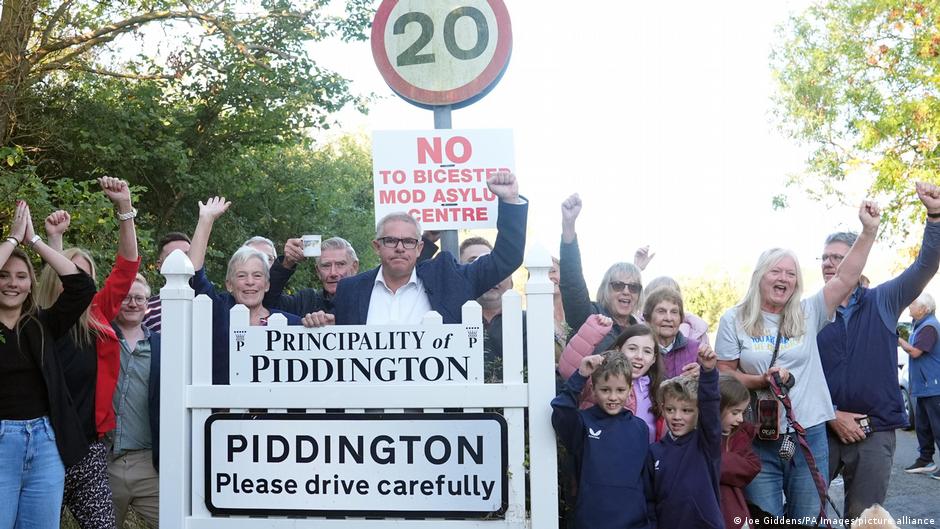
An English village of about 350 people has voted to "secede" from the United Kingdom, in a symbolic protest against government plans to set up an asylum reception center nearby. Residents of Piddington, about 25 kilometers (15 miles) northeast of Oxford, celebrated with a placard reading "Principality of Piddington" near the village road sign on Wednesday. They oppose plans, still under review, to house asylum seekers in a disused military base, MoD Bicester (Site A).
The village's parish council said that 312 people cast ballots in the vote, a turnout of almost 92%. Participants in the vote, which had no legal basis, were asked to agree or disagree with the statement: "I support Piddington seeking to secede from the United Kingdom and pursuing self-determination." Of them, 285 voted to secede, 26 voted against, and one spoiled their ballot. Parish council chair Tim McNally said that, going forward, the village would identify as the "Principality of Piddington." "For us, it's about proportiality," McNally told Sky News.
"How does a small village of 350 odd people assimilate with 1,250 males?" He accused the government of "trying to rush this whole plan through." An Oxfordshire County Council official told the BBC the plan risked making the village and the facility a "lightning rod" for potentially violent far-right protests. The vote attracted the attention of self-styled anti-migration "influencers" online. The Labour government has been trying to move asylum seekers housed in hotels, an unpopular legacy they inherited from previous British governments, into disused military facilities by 2029.
This follows repeated protests at or near hotels and rented accommodation used for the purpose. Prime Minister Andy Burnham, who only recently took over the rapidly rotating top job in British politics, promised to "look at the issues raised by the community and in the referendum." But he also said that the "vast majority" of British people backed a government plan to stop housing asylum seekers in hotels and argued that it was "fair" to locate holding centers around the country. Speaking to the BBC, Culture Secretary Lisa Nandy said a former military base was "a better option for housing asylum seekers" than hotels or rented accommodation.
One drawback with disused military bases, however, is that they are often intentionally placed in remote and rural areas. This can be ideal for military training and activity, but is less obviously suited to housing migrants with limited mobility and resources. Migration and asylum have been contentious political issues in the UK for decades.
But successive governments have faced particular pressure in recent years, with the populist right-wing Reform UK and Restore Britain parties gaining ground against the established political giants the Conservatives and Labour. The most recent manifestation of this was anti-migrant protests in the coastal city of Portsmouth earlier this month. To view this video please enable JavaScript, and consider upgrading to a web browser that supports HTML5 video In a Q+A published in July about its plans for Ministry of Defense (MoD) Bicester (Site A), the British government said the site "would provide basic, safe accommodation and would be designed to be largely self‑sufficient to minimize any impact on the local community." It stressed the plan was still subject to feasibility studies, planning permission requirements and other red tape.
Extract — continue reading at the source.