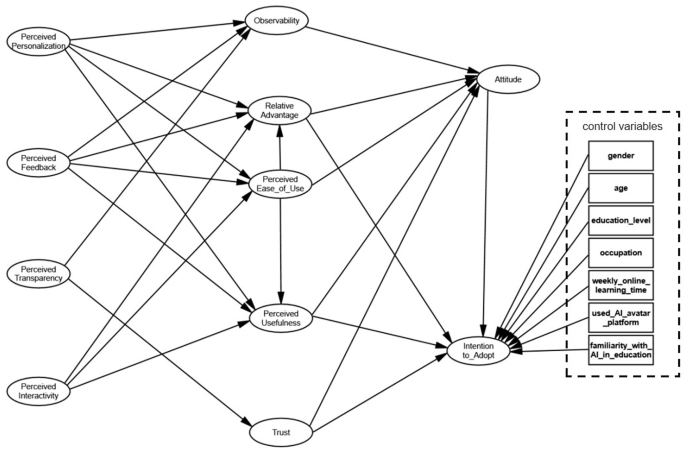
This research examines the key factors associated with users’ intentions to adopt AI avatars within online learning environments. By combining the Technology Acceptance Model (TAM) and the Diffusion of Innovations (DOI) theory, a comprehensive model was proposed to assess the relationships between four primary design elements—perceived personalization, feedback quality, transparency, and interactivity—on five key constructs: observability, relative advantage, perceived usefulness, perceived ease of use, and trust, as well as users’ attitudes and willingness to adopt. Data were collected through a structured questionnaire using convenience sampling, yielding 653 valid responses from participants experienced with AI-powered online education platforms.
Structural equation modeling (SEM) analysis was used to examine the proposed TAM–DOI framework and the relationships among the study variables. Notably, trust is closely associated with transparency and other design perceptions, as well as users’ attitudes and behavioral intentions. These findings offer practical guidance for the design of AI-powered educational tools, emphasizing transparent, personalized, and feedback-driven systems that support user trust in online learning.
Recent developments have highlighted artificial intelligence (AI) as a catalyst for change within online education, drawing significant academic interest (Seo et al. 2021). AI avatars, as a subset of AI-driven tools, serve as virtual representations that facilitate interactive and personalized learning experiences, providing users with adaptive guidance and support (Seo et al. 2021; Vallis et al. 2024). Adopting AI avatars in online education has been associated with higher levels of user engagement and satisfaction, suggesting its potential relevance for future learning innovations (Fink et al. 2024).
Despite the significant interest and potential, there remains a gap in empirical research regarding user acceptance of AI avatars in online learning environments. While system functionality and instructional outcomes have been the primary focus of most studies, user acceptance, particularly the role of design characteristics in adoption, has received less empirical attention (Seo et al. 2021). Moreover, studies investigating AI avatars in learning environments frequently neglect the interaction between design features and user evaluative dimensions, including trust and perceived value, that are closely related to users’ perception formation (Gefen et al. 2003; Mäntymäki 2008).
In addition, empirical investigations into how specific design features relate to trust and adoption behaviors remain limited within online learning environments (Grivokostopoulou et al. 2020; Nyaaba et al. 2023). This research gap highlights the need for a more comprehensive framework to explore these factors. In response to these gaps, this study integrates two well-established theories, the Technology Acceptance Model (TAM) and the Diffusion of Innovations (DOI) theory, to provide an integrative framework for understanding how design features relate to user adoption of AI avatars.
TAM explains users’ evaluations—such as perceived usefulness and ease of use—but often overlooks social and contextual dimensions of acceptance. Conversely, DOI emphasizes the role of innovation attributes, including relative advantage and observability, while giving less attention to individual user-related evaluations such as trust and perceived usability. In the context of AI avatar–based online learning, adoption involves both evaluations of system use and innovation-related attributes.
Extract — continue reading at the source.


