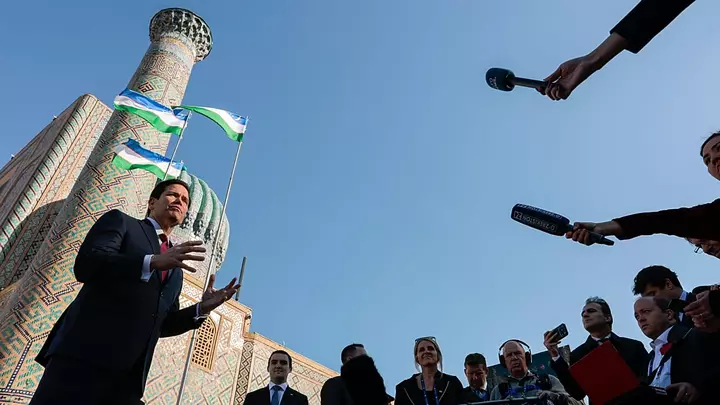
US companies were preparing to announce new agreements in Uzbekistan as Washington seeks to expand its economic presence in Central Asia and diversify critical mineral supplies, US Secretary of State Marco Rubio told Euronews on Monday. Speaking to reporters during a visit to Samarkand, Rubio said the deals could mark the start of broader US engagement with a region he believes American policymakers have paid too little attention to. Asked by Euronews what people in Uzbekistan could expect from the visit and the accompanying business delegation, Rubio said, "I think we'll have some concrete deals to announce." He said US companies were keen to do business in Uzbekistan and that announcements would follow the forum's meetings.
This is the beginning," he added. Rubio said nearly 300 American businesses were represented in Samarkand, where they were discussing agreements potentially worth billions of dollars. The US State Department had previously said more than 200 US business leaders were accompanying his trip.
No final list of agreements or values had been announced at the time of his remarks. In response to a second question from Euronews, Rubio identified critical minerals as an area for potential cooperation with Uzbekistan. "It's not smart just for the whole world to depend on one place for 100% of anything," he said, stressing that he was not singling out any particular country.
He argued that industries and technologies likely to shape the 21st century would increasingly rely on critical minerals, making supply-chain diversification an international priority rather than solely a US concern. He said that for resource-rich countries, developing mineral deposits and processing capacity responsibly could also serve their own economic interests. "We're obviously going to explore that and I think we have a chance to do that here," Rubio told Euronews.
The subject was also discussed at the C5+1 summit US President Donald Trump hosted in Washington in November 2025. Uzbekistan and its neighbours have been seeking additional investment and technology to develop their mineral resources, while the US and Europe are looking for alternatives to highly concentrated supply chains. Asked separately about China's growing economic influence in Central Asia, Rubio described US involvement as competition, not an attempt to make regional governments choose sides.
"This is not about coming here to say, stop talking to somebody else or stop working with some other country," he said, describing Uzbekistan as open to economic relationships with different partners and praising its economic growth. Rubio began Monday's programme with a morning tour of Registan Square, Samarkand's historic architectural landmark, alongside Saida Mirziyoyeva, Head of Uzbekistan's Presidential Administration. He called the city a centuries-old crossroads of trade and commerce.
Extract — continue reading at the source.