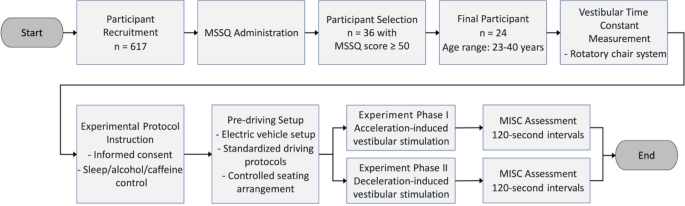
Motion sickness is an important challenge for the acceptance of autonomous vehicles. Although the Motion Sickness Susceptibility Questionnaire (MSSQ) is widely used, it relies on retrospective self-report and does not directly capture vestibular characteristics. This study examined the association between the vestibular time constant (VTC), which reflects the velocity storage mechanism, and motion sickness severity during on-road driving.
VTC was measured in 24 female adults; 21 completed four 30-min acceleration sessions, and all 24 completed nine 30-min deceleration sessions involving regenerative braking. Motion sickness severity was repeatedly assessed using the Misery Scale (MISC). MSSQ scores showed weak, non-significant associations with MISC-derived outcomes, whereas longer VTCs were associated with greater symptom severity, particularly under deceleration and among participants who developed symptoms.
Participant-level receiver operating characteristic analyses showed that the VTC discriminated participants who reached the nausea threshold (MISC ≥ 6) better than the MSSQ. Under deceleration, this difference was significant (area under the curve, 0.89 versus 0.60; DeLong p = 0.048). VTC associations were descriptively stronger under deceleration, possibly reflecting condition-specific characteristics of braking-related vestibular stimulation.
These findings indicate that the VTC provides objective physiological information that may complement questionnaire-based susceptibility assessment in automotive environments. Open Access funding enabled and organized by Projekt DEAL. Chair of Acoustics and Haptics, Institute of Acoustics and Speech Communication, Faculty of Electrical and Computer Engineering, Technische Universität Dresden, Helmholtzstrasse 18, 01069, Dresden, Germany Research and Development Division, Hyundai Motor Company, Hyundaiyeonguso-ro 150, Hwaseong-si, 18281, Gyeonggi-do, South Korea Department of Otorhinolaryngology–Head and Neck Surgery, Hallym University College of Medicine, Gwanpyeong-ro 170-22, Anyang-si, 14068, Gyeonggi-do, South Korea The authors declare no competing interests.
Springer Nature remains neutral with regard to jurisdictional claims in published maps and institutional affiliations. Below is the link to the electronic supplementary material. Open Access This article is licensed under a Creative Commons Attribution 4.0 International License, which permits use, sharing, adaptation, distribution and reproduction in any medium or format, as long as you give appropriate credit to the original author(s) and the source, provide a link to the Creative Commons licence, and indicate if changes were made.
The images or other third party material in this article are included in the article’s Creative Commons licence, unless indicated otherwise in a credit line to the material. If material is not included in the article’s Creative Commons licence and your intended use is not permitted by statutory regulation or exceeds the permitted use, you will need to obtain permission directly from the copyright holder. To view a copy of this licence, visit http://creativecommons.org/licenses/by/4.0/.
Extract — continue reading at the source.