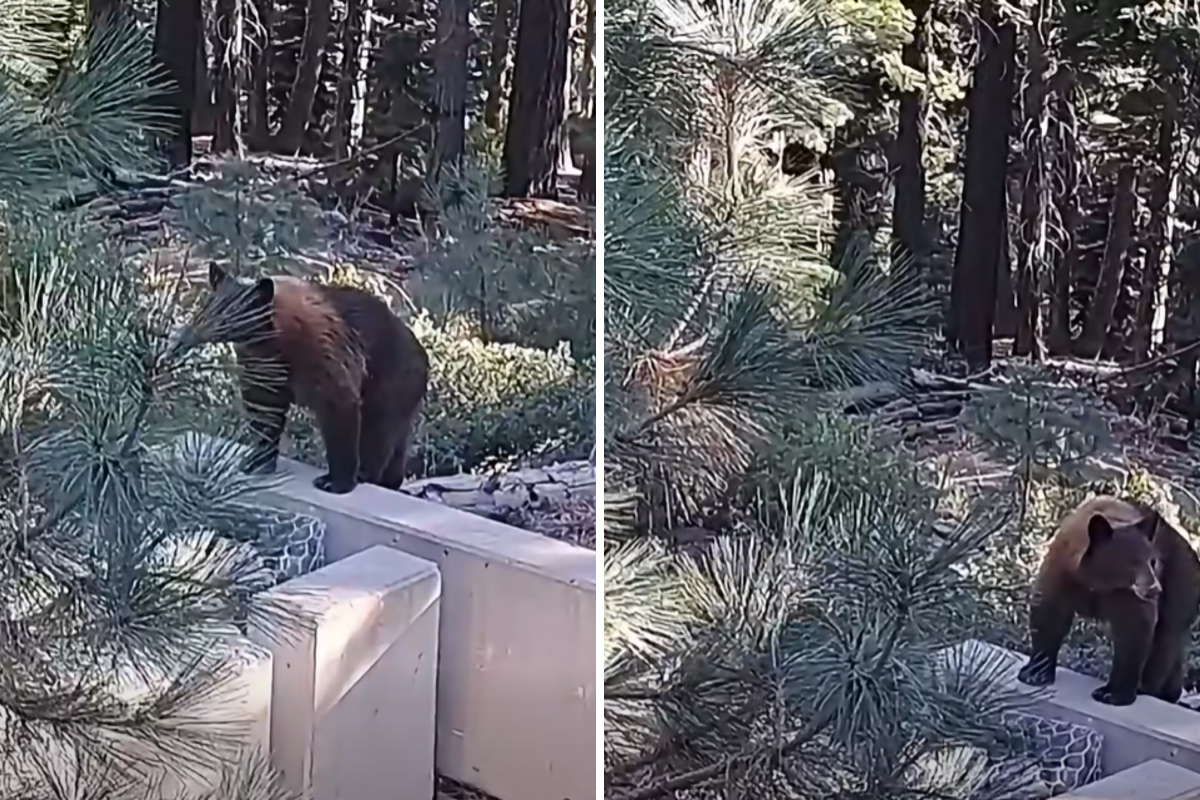
Video shows a mother bear pacing through a wooded area near Truckee, California, repeatedly lifting her head and calling for her last surviving cub after it was fatally struck by a vehicle—two weeks after her other cub was killed on the same road. The video, shared by the BEAR League, a nonprofit that promotes coexistence between people and black bears in the Lake Tahoe Basin, Truckee and surrounding areas, shows the bear moving back and forth beside a low concrete barrier as she looks into the surrounding forest. The organization said three members of its response team remained at the scene for several hours, trying to keep the mother away from traffic as she “searched and called for her baby on into the night.” The cub died after being struck by a vehicle, becoming the mother’s second cub to be killed on the same road in two weeks, the organization said in the video's caption.
Witnesses told the group that the animal screamed and writhed after the collision. The driver who hit it was “terribly traumatized,” the BEAR League said, while another motorist reported that swerving could have caused a potentially fatal crash. The organization was responding simultaneously to another collision near Truckee in which a different cub was injured but eventually limped away with its mother and sibling.
It comes against the backdrop of several recent cub deaths on Lake Tahoe-area roads, with wildlife advocates calling for motorists to slow down and for officials to consider lower speed limits. The BEAR League stressed that such crashes do not always result from irresponsible driving, arguing that the region’s speed limits can leave motorists with too little time to react. The cubs' deaths come amid heightened concern over bear-vehicle collisions around Lake Tahoe.
Six cubs were killed on area roads in a two-week period, including one on Highway 89, two on Highway 267 and three in South Lake Tahoe neighborhoods, according to KOVR in West Sacramento, California. Following the latest crash, the BEAR League called for lower speed limits around the lake. She wants communities around Lake Tahoe to install portable, light-up signs that are more likely to catch drivers’ attention and make them slow down.
The wider Tahoe Interagency Bear Team—a coalition of federal, state and local wildlife specialists—has urged motorists to slow down and remain particularly vigilant at dawn, dusk and night. The team warns that when one bear crosses a road, others may follow, because cubs often trail their mother. The risk rises as bears enter hyperphagia, the period of intense feeding before winter.
Bears may consume as many as 25,000 calories a day and spend much of their time searching for food, increasing their movement across the region. The Interagency Bear Team said bear-vehicle collisions have increased around Tahoe during the summer. Wildlife officials advise motorists who encounter a bear to reduce their speed and look for additional animals but not to swerve or stop in the roadway.
Extract — continue reading at the source.