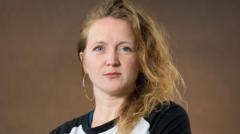
'Virginity is a myth we've given too much power' lie McNish says she has always found the concept of virginity "weird and kind of frightening" When the poet Hollie McNish lost her virginity at the age of 19, she stared at her face in the mirror for half an hour, expecting some sort of transformation.She wondered how to stand like a non-virgin so her family would not guess, and worried her parents were looking at her weirdly across the dinner table, while they all ate mashed potato.The word virgin might only have six letters, but not many other words carry as much power, she says."Virgin is my least favourite word in the English language," she tells an audience of hundreds at Latitude Festival, in Suffolk."Life is full of first times but nothing else is sold as being powerful enough to change our entire state of being - from virgin to non-virgin."The concept of virginity, and love in general, are the focus of the the 43-year-old's latest collection, Virgin. McNish won the Ted Hughes Award for her book Nobody Told Me, a collection of diary entries she kept from the moment she discovered she was pregnant until her daughter was threeMcNish, who lives in Cambridge with her 16-year-old daughter, first heard the word aged five, performing in her school nativity. "I knew it was virginity that made Mary special.
Joseph's virginity was never mentioned."I've always found it weird and kind of frightening the way we speak about this concept."The question "have you lost your virginity yet?" was a recurring one with friends throughout her teens.McNish says virginity is a man-made myth created by those in power, in times that "also spoke positively of slavery and stoning".It has been used across cultures to control, shame, praise, and define people, especially women, she adds.'I lost nothing except a sandal'McNish hopes young people can enjoy their bodies and not feel less pure, or ashamed, by having consensual sex."My first attempt at intercourse was nice. It did not hurt, as rightly it should not, no matter the horrendous narrative about first time pain being some sort of marker of purity. I lost nothing except a sandal," she says.McNish reaches millions of people through her books, performances, and short videos on social media, making her one of the UK's most widely shared poets.
She wrote her first poem aged seven, furious her family would not let her get a cat."My mum found it in the attic and it was funny to read back, I was insulting them in rhyme. Writing poetry has always been the way I've coped with things and worked stuff out," she says.In her teenage years, she doodled poems in her diaries and made up verses about physics to help her remember things for her exams. "It made stuff I hated fun," she says.But she fell out of love with poetry when she was forced to learn it at school."I remember reading the Seamus Heaney poem Digging, and thinking 'why are we reading a poem about potatoes'.
Now he's one of my favourite poets, but it was just another subject I had to learn." her poems are "pretty much word-for-word how I'm thinking"McNish could not find time to write poetry while studying modern and medieval languages at the University of Cambridge, where she stayed on to gain a masters in economics.She describes getting into the prestigious university as "a massive deal" but she found the atmosphere strange and experienced some snobbery about her working class accent."Some students did make fun of the way I speak, though I didn't get as much stick as anyone from the north of England. "I wanted to play lacrosse, because I'd gone to the only state school that played it, but it wasn't for me. When I mentioned my address, one player said she'd always wanted to meet someone with a house number [rather than a name] and another said it was cute that my mum was a nurse." .
Hollie McNish performs her piece 'Mathematics', which she wrote about the logic used by some people who protest against immigrationMcNish began writing poetry again after graduating and started reading her pieces at open-mic nights. "I loved reading and I loved writing, but being a writer didn't really enter my mind. I got asked to do more and more gigs and suddenly it became my full-time job," she says.McNish has also faced snobbery in the poetry world.
Her poems have been described as basic. She is often lumped in with spoken words poets (she does perform her poetry but does not write it specifically to be spoken) or even referred to as an Instagram poet."My poems are pretty much word for word how I'm thinking. I want people to understand them.
Extract — continue reading at the source.