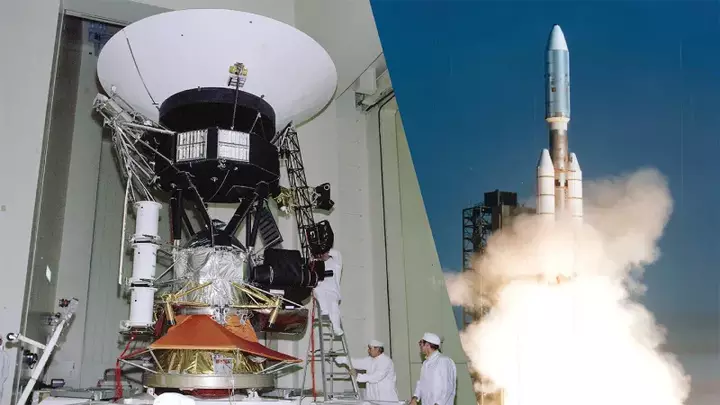
NASA’s Voyager 1 spacecraft has been breaking distance records for decades. Launched almost 50 years ago, it became the farthest human-built object from Earth when it overtook the pathfinding Pioneer 10 probe in 1998. It was the first spacecraft to leave the solar system’s protective bubble, and it will be humankind’s first emissary to the stars.
The cameras on Voyager 1, along with those on its twin spacecraft, Voyager 2, captured powerful megastorms in the outer solar system, the first images of dozens of moons and never-before-seen details of the gossamer rings around Jupiter, Saturn, Neptune and Uranus. The images and data sent home have shaped theories of how the solar system formed and evolved, inspired subsequent missions and posed enough new questions to keep space scientists busy for decades. And this month, Voyager 1 will set another big record.
On November 18 at 5:16:07 a.m. Eastern Standard Time, it will become the first spacecraft to reach one light-day from Earth: the distance light travels in 24 hours. That’s a journey of 25.9 billion kilometers, or more than four times the distance from the sun to Pluto.
At that point, signals from Earth will take a full day to reach Voyager 1; it will take another day to hear back. Spilker was in Cape Canaveral, Fla., for the first launch. She even planned the births of her children, now in their 40s, around mission milestones.
After stepping away to lead another mission, she is now back as Voyager head scientist. Two other scientists have been with Voyager since the beginning. Others weren’t yet born when the spacecraft launched.
But it isn’t a mission of nostalgia. There’s still a world of discovery out beyond the solar system’s edge. A rare planetary alignment meant that a spacecraft launched in the late 1970s could swoop past Jupiter, Saturn, Uranus and Neptune, getting a gravitational boost from each planet that it passed.
Extract — continue reading at the source.