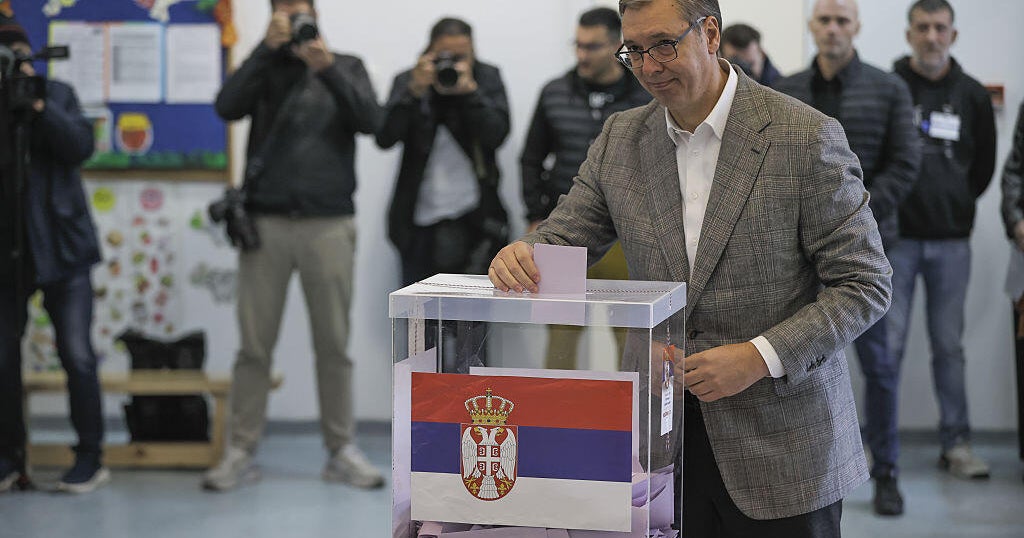
The long-serving strongman leader of Serbia, Aleksandar Vucic, conceded defeat on Sunday in an election that pitted him and his right-wing party against a diverse student-led opposition movement that spent two years protesting his government. It was a seismic political shift in the Balkan country where Vucic, who had been endorsed by Russian President Vladimir Putin and who denounced the student movement as a foreign-led attempt to unseat him, led with virtually absolute power for 14 years. High turnout and gathering tensions marked the highly contested parliamentary election that was a showdown between Vucic and his right-wing Serbian Progressive Party and university students who, accusing the government of corruption and dismantling democracy, had built a popular following across the country.
Serbia's 6.4 million voters were electing lawmakers to the 250-member Parliament. In conceding the election, Vucic said his party projects that his opponents, the youth-backed Students' List, will take between 135 and 140 seats while his SNS party will have around 105. "The Students' List has won," Vucic told supporters at his party's election night event, though he blamed Serbia's independent media as well as alleged interference by unnamed European countries and an "American deep state" for the loss.
Vucic said that his SNS party won around 1.7 million votes compared to the Students' List, which he said took around 2.2 million. Supporters of the Students' List immediately flooded onto the streets of Belgrade and other cities, honking horns, shouting and chanting: "Aleksandar is gone," referring to Vucic. The outcome, which Vucic announced only around an hour and a half after polls closed, came after tensions had built as voting progressed during the day.
Police in anti-riot gear cordoned off an area in central Belgrade around the election commission headquarters. Special police vehicles could be seen near a Belgrade park where Vucic's loyalists have been camping for over a year, and large groups of black-clad men had congregated at various points throughout the city. Vucic was seeking to become Serbia's prime minister after serving two near-full terms as president.
He resigned the presidency last month to lead the campaign. Support for the populist had eroded since 16 people were killed in 2024 when a concrete canopy collapsed at a train station in Novi Sad. That set off a wave of youth protests that blamed the collapse on high-level corruption, cronyism and rampant graft during renovation work at the station.
Despite the protests, Vucic retained considerable support among many of Serbia's voters. Admirers viewed him as a capable leader who can steer the nation through global uncertainties - the image that was carefully crafted by the mainstream media. While the increasingly authoritarian Vucic has routinely outplayed Serbia's fractured opposition in the past, the leaderless youth movement proved to be a tough opponent that rattled his firm grip on power in Serbia like no one else in the 14 years since his party took office.
Extract — continue reading at the source.