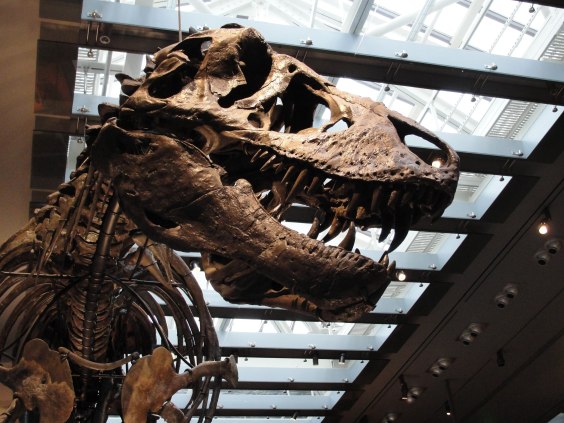
Whether dinosaurs were warm-blooded or cold-blooded has been the subject of debate for years. While the scientific consensus has shifted decidedly in the warm-blooded direction, just how warm their blood was has been something of a mystery. But now a team of researchers led by geobiologists from the University of California, Los Angeles have pinned down the internal body temp of Tyrannosaurus rex using only its tooth.
T. rex teeth aren’t exactly easy to come by, but the team came prepared with a technique that used 90 percent less sample material for the test. Rex from the Natural History Museum of Los Angeles County generously donated one of his chompers in the name of science. The researchers drilled minuscule bits of enamel and dentin from the tooth and sent it off for chemical analysis via mass spectrometry.
By determining the number of bonds between isotopes of carbon and oxygen within the tooth material (fewer for warm-blooded animals, more for cold-blooded animals), the team was able to nail down a body temperature range for Thomas and other T. rexes. The temperature is about what I would have guessed—higher than a reptile or a slow mammal like a sloth, but lower than an avian.” Read more: “Here’s How Fast An Adult Tyrannosaurus Rex Walked” Cold-blooded reptiles typically regulate their body temperatures behaviorally (i.e., basking in the sun) and run somewhere around 82 to 86 degrees Fahrenheit (they also get sluggish when it’s chilly). Non-avian dinosaurs (birds) run quite a bit hotter at 104 to 109 degrees Fahrenheit.
It’s another clue that T. rex was an energetic predator (or maybe scavenger) with a fast metabolism. It also explains why T. rex fossils have been found as far north as Alaska, even though those from lizards, turtles, and other reptiles haven’t. While there’s some minor quibbling about how frigid Alaska was during the Cretaceous, there’s a general consensus that it was too nippy for cold-blooded animals to survive (especially during the winter).
In other words, Tyrannosaurus rex wasn’t just another active, hot-blooded predator, it was one with quite an extensive geographic range. Subscribe to our free newsletter. Lead Image: Dinosaur Institute, Natural History Museum of Los Angeles County
Extract — continue reading at the source.