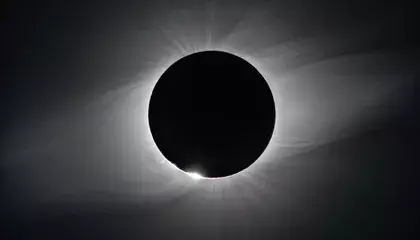
To many ancient civilizations, astronomical events signaled big changes in the human world. Eclipses in particular were linked to military defeats and the deaths of kings. If astronomers didn’t pay proper attention to the night sky, they could face political punishment.
One such story out of ancient China allegedly traces back to October 22, in the year 2134 B.C.E. (Other versions of the tale offer different timelines.) On this fateful day, two royal astronomers often identified in modern sources as Hsi and Ho are said to have neglected their duties to grab a drink. As a result of their drunken reeling about town, the pair apparently failed to predict an eclipse or perform the proper eclipse rituals—or maybe even both. Either way, the ruler wasn’t happy.
In the thousands of years since this purported event, the anecdote has hopscotched from early Chinese texts to periodicals, newspapers, journal articles, books and social media. But just how truthful is this tale? No evidence supports the idea that the two men mentioned in the story even existed, he adds.
So why has this dubious legend—which the New York Times, in a 1970 article, deemed “the earliest written record of a total solar eclipse to survive through the ages”—had such sticking power? It’s true that royal astronomers had a lot of responsibility on their shoulders. Astronomy in ancient China Given the societal importance of the cosmos, records of Chinese astronomical observations were “pretty exact” even as far back as the third or fourth century B.C.E., McLeod says.
The ancient Chinese “were excellent observational astronomers,” he adds. Even though celestial events were strongly linked to ancient politics, the eclipse story’s reliability remains doubtful, historians say. In 2134 B.C.E.—the year that some sources say the incident occurred—Chinese astronomers didn’t actually know how to predict eclipses.
It was only under the Han dynasty (206 B.C.E. to 220 C.E.) that such experts managed to anticipate eclipses with some success. One account from the 170s C.E., for example, suggests that a royal astronomer correctly predicted a December 8 solar eclipse by analyzing earlier eclipse observations, although his predicted location was rather off. Some scholars dispute that the Hsi and Ho legend is even about an eclipse.
Extract — continue reading at the source.