Imagine waking up in a zippered sleeping bag 250 miles above the ground, contained in a vessel traveling five miles per second in a permanent state of free-fall. Each day includes about two hours of exercise to stave off the atrophy of your bones and muscles. And to get home, you must blast through Earth’s atmosphere in a spacecraft.
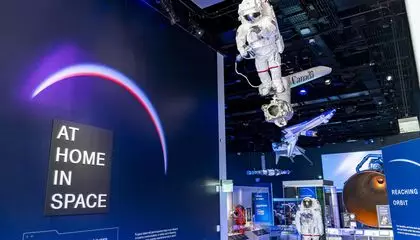
This is life on the International Space Station, where groups of humans have lived and worked continuously for nearly 26 years. Research done in Earth’s orbit, she adds, is seeking to find out “what space can offer humanity.” Reaching an answer will require traveling to—and living in—microgravity. One of the museum’s newest galleries, “At Home in Space,” captures that idea, demonstrating how humans have built a sustained presence off Earth’s surface.
The newly renovated hall features one of the main engines from the space shuttle program; a mock-up of the International Space Station’s Destiny module for American science research; a multiplayer, interactive quiz game about space travel; and a quarter-scale model of the Orion spacecraft, eventually to be replaced by the real artifact from Artemis 1. The unveiling of these two halls marks the end of the nearly decade-long renovation process that has seen the Washington, D.C. building be renewed and reimagined. Beginning in 2018, galleries were closed and reopened in phases for “the most extensive project the museum has ever undergone,” director Chris Browne says in a statement.
Levasseur says she hopes that visitors will leave with an appreciation of not just the astronauts who dwell in space, but all the people on the ground who make their work possible. For instance, research from the space station, modeled in the museum’s mock-up Destiny lab, has revealed something strange about the way proteins grow in microgravity. Unencumbered by the force of gravity’s pull, protein crystals in space grow larger and more uniformly compared with those on the ground.
This could lead to new drug formulations that can’t be made on Earth. Certain cancer treatments, for example, require an IV infusion, which can take upwards of 30 minutes to administer. That’s because these medications need a large dose of liquid that is too thick to be delivered by injection.
But space-grown proteins could change that: “You can get these really concentrated formulations that will have a low enough viscosity that they can still flow through the needle,” Katie King, co-founder and chief executive of the biotechnology company BioOrbit, told the Guardian’s Julia Kollewe in May. The pharmaceutical company Merck has used protein research from onboard the space station to inform delivery of its injectable cancer medication pembrolizumab, marketed as Keytruda, which the Food and Drug Administration approved in September 2025. Instead, they can just get a quick shot at the doctor.
Extract — continue reading at the source.