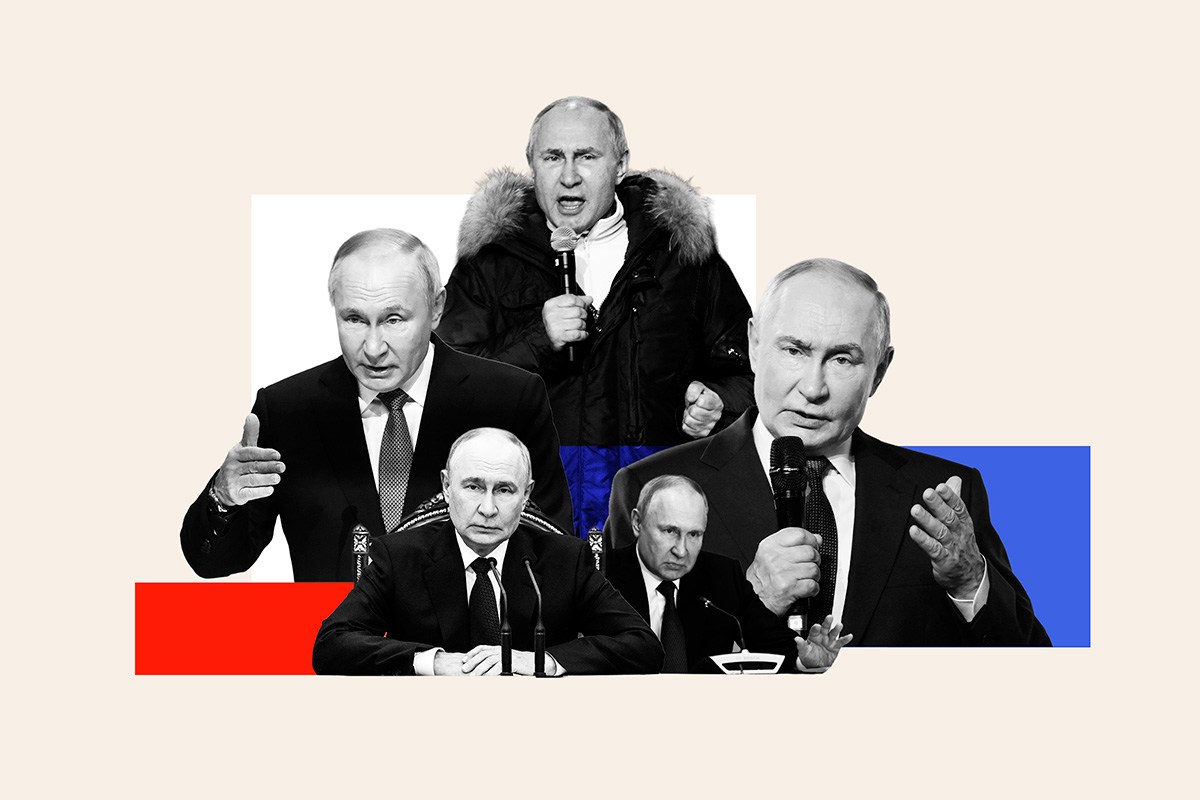
The 21st century does not know a Russia without him as either president or prime minister. Western journalists, diplomats and even former U.S. presidents have testified to Putin’s political guile; few world leaders choose their words more carefully, or can express themselves so eloquently. But not even a man of Putin’s intellect and experience can continue telling the same exact story when the reality around him keeps changing.
Viewed in isolation, each of the Russian president’s speeches and statements sounds well polished, even after four-and-a-half years of war in Ukraine. Zoom out a little, though, and cracks begin to appear in the carefully curated narrative. From before the full-scale invasion to today, his own words reveal what has changed, what has stubbornly remained the same—and what that tells us about the war Russia is really fighting.
Less than one year before he unleashed the full-scale invasion of Ukraine, the Russian president published an op-ed on the Kremlin’s website. You can tell from the title—On the Historical Unity of Russians and Ukrainians—it offered a preview of what was to come. Besides an opportunity to show off his knowledge of history—his version, at least—Putin’s July 2021 essay centers on one foundational argument: that Ukraine exists as a state entirely because of, thanks to, and at the expense of Russia and the Soviet Union.
"Modern Ukraine is entirely a product of the Soviet era," Putin wrote, before lamenting that historical Russia "was, in fact, robbed" of its land when Lenin’s Bolsheviks "drew borders arbitrarily and handed out generous territorial gifts." What emerges is a paradox in which Putin claims he "respects Ukrainian language, traditions," and desires to live in a state that is "free, secure and prosperous"—just so long as that state never emerges from Russia’s sphere of influence. "I am convinced that Ukraine’s true sovereignty is possible only through partnership with Russia…After all, we are one people." Fast forward seven months, and more than 150,000 soldiers are massing on the edges of Ukraine, waiting for the order to launch their assault. Putin is done with brotherly sentiments of unity; Ukraine is now an insolent child that must be disciplined by Mother Russia.
In his address to formally recognize Ukraine’s Donetsk and Luhansk regions as independent republics on February 21, 2022, the Russian president said Ukraine "never had a stable tradition of its own genuine statehood" and criticized the government for "losing national character." He mocked protesters pulling down statues of Lenin and issued a bald-faced threat: "You want decommunization? We are ready to show you what real decommunization means for Ukraine." Three days later, Russian helicopters and fighter jets soared into Ukrainian airspace as tanks began barreling toward Kyiv. But this was not a war; it was merely a "special military operation." Putin styled his invasion as a necessary corrective measure to bring an unruly junior misguided by nefarious, Russian-hating forces back under Russia’s wing, and to defend the Russian people from NATO enlargement and Western-backed "neo-Nazis." He also justified the special military operation by claiming the "People’s Republics of Donbas"—which he had officially recognized only three days earlier—had appealed to the Kremlin for help.
"We are simply left with no other option to defend Russia and our people other than the one we are forced to use today…the goal is to protect people who have been subjected to eight years of abuse and genocide at the hands of the Kyiv regime. To this end, we will strive for the demilitarization and denazification of Ukraine," Putin declared. But still the Russian president tried to convince Ukrainians, and the world, that he had their best interests at heart.
Extract — continue reading at the source.