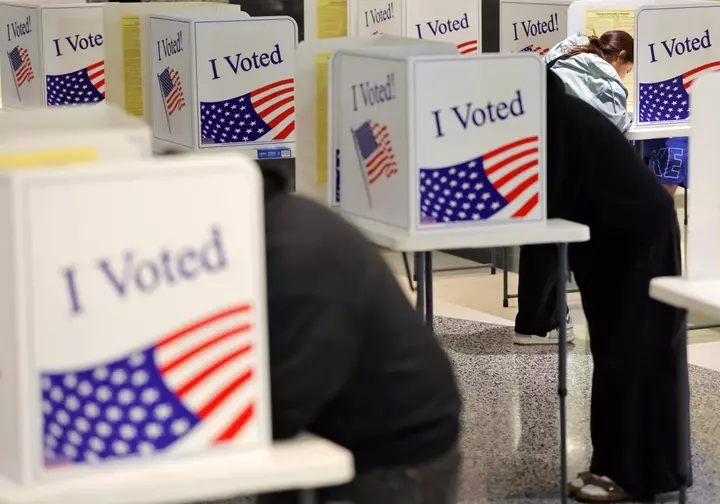
Democrats have taken back control of both the House and the Senate, in a sweeping blue wave that has dealt President Donald Trump a major political blow halfway through his second term in the White House. In the Senate, Democrats have secured 54 seats to Republicans' 44, with two races still outstanding. They have so far flipped seven Republican-held seats.
In the House, Democrats have picked up 25 Republican-held seats, so far winning 228 seats to Republicans' 139, with 68 races yet to be called. While midterm elections typically favor the party out of power, the scale of this year's result points to a broader rejection of the Republican administration. In the lead-up to the election, Trump's approval ratings had fallen close to their lowest point, amid widespread voter dissatisfaction with the cost of living and the war in Iran.
The president had also made himself a central figure in the campaign, repeatedly urging supporters to vote as if he were on the ballot. Yet as the results came in, he sought to distance himself from the defeat, writing on Truth Social: "I wasn’t on the Ballot and if I was, we would have won IN A LANDSLIDE!" The result give Democrats control of Congress for the final two years of Trump’s presidency, handing them significant power to obstruct his legislative agenda and investigate his administration. Before the midterm elections, Republicans held 218 seats in the House, while Democrats held 214.
The Cook Political Report had projected Democrats would gain between 12 and 25 House seats, potentially giving them as many as 240 in total. Democrats have already flipped 25 Republican-held seats, reaching the upper end of that projection. Since 1946, the party controlling the White House has lost House seats in 18 of 20 midterms, with an average loss of about 26 seats.
The largest House midterm loss for a president's party in the modern era came in 2010, when Democrats under Barack Obama lost 63 seats, falling from 257. The defeat came amid opposition to the Affordable Care Act, sluggish economic recovery from the Great Recession and the rise of the conservative Tea Party movement. Republicans are unlikely to face the same scale of loss this year in absolute terms, having gone into the election with fewer House seats, at 220.
However, the final results could still amount to a comparable setback for Republicans. Beyond the historic loss of 2010, several other presidents have suffered heavy midterm defeats. Two presidents in the postwar era have lost 50 or more seats: Harry Truman’s Democrats lost 56 in 1946, while Bill Clinton’s Democrats lost 54 in 1994.
Extract — continue reading at the source.