In some ways, we know aging when we see it, from the graying of hair to the wrinkling of skin to declines in motor, sensory, and cognitive capacities. Yet the underlying biology of aging remains a matter of uncertainty and debate. Many lines of research align with the theory that aging is a direct result of decay — the inevitable degradation of molecules (including proteins or DNA), organelles, cells, or whole organs — from external assault or inexorable breakdown.
When the body’s repair mechanisms fail to keep pace with these changes, like a factory with deteriorating equipment and too few mechanics, it manifests as the known signs of aging and, eventually, death. The idea makes a lot of sense, but according to the cell biologist Junyue Cao, it’s inaccurate. Far from a random but linear process of wear and tear, he argues, aging is a stepwise, programmed, orderly affair.
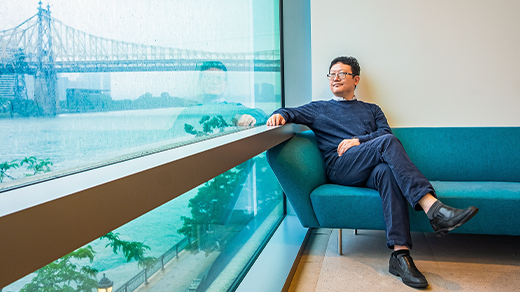
Using technology that offers a systemwide view of the aging process in mice, Cao has outlined discrete stages of aging, akin to those of embryonic development, that are defined by changes in molecular signals and specific cell populations. In humans, the process likely begins before age 30. Cao’s interest in aging began in high school in Hebei, China, when he became acutely aware that his grandparents and parents were not going to live forever.
While many teenagers awakening to mortality might turn to poetry or self-destructive behavior, Cao turned to science. Finding a way to slow aging became his lifelong goal, and it’s why he chose biology as his major at Peking University in Beijing. Initially, Cao assumed that the deterioration of particular proteins and protein networks was responsible for aging, in line with the prevailing model.
But then after college, when he was working in a lab trying to identify those proteins, he realized that a daunting number of them were associated with aging, and that their effects depended on the type of cell in which they were operating. It was a picture both more complex and more organized than he had thought. Cao decided he needed data — lots of it — on thousands of molecular changes across hundreds of cell types.
As a graduate student, he developed a high-throughput technology that could quantify these dynamics in embryonic development. When he started his own lab at Rockefeller in 2020, he put this technology to work on aging.
Extract — continue reading at the source.