Women’s historical fiction and historical romance are currently more popular than ever, but women’s historical nonfiction? Despite being a biographer, when choosing books for pleasure, I’m still drawn again and again to fictional retellings of women’s history rather than nonfiction ones. They’re not only more compelling (as all fiction tends to be when plots can be crafted rather than proved by citation), but they also let me engage more of myself on their pages.
The fiction gives an immersive experience of women’s viewpoint. In nonfiction of women’s histories, particularly biography, there is a pesky prominence of men’s point-of-view. The practical reasons for this are numerous, from lack of research availability to the popularity of men’s history to the appeal for men readers and critics’ approval.
I’ll argue that this skew in perspective, where men’s perspectives and voices eclipse women’s, is a major reason for its lesser popularity among women readers. But when women’s biographies continue to win Pulitzers while prioritizing the male point-of-view, what incentive is there to do otherwise? Still, despite the fact the I might not be rewarded by prize committees, when writing my own historical nonfiction, I needed women’s voices to be not just a priority, but the priority.
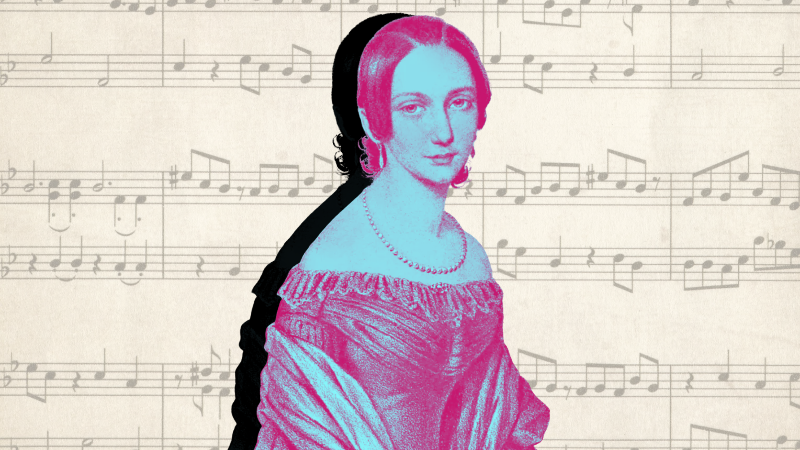
Because I wanted to write a book I enjoyed reading, one that left me, and my women readers, feeling centered and not secondary. Another major obstacle, often confronted by the woman’s biographer, is her own self-perception. Even though the Bechdel test was not intended for nonfiction application, I decided to try it on my new biography for Pegasus Books: Madame Composer: The Virtuosic Genius of Clara Schumann.
Every time I found brief mentions in diaries and letters of Clara’s conversations with fellow women composers, even though these could have easily been cut, I included them. I also played a game with myself—could I write a biography where not a page went by without Clara’s point-of-view? I’m fairly sure I succeeded, though not without considerable effort or without confronting innumerable obstacles.
Luckily, with Clara Schumann, lack of information—the problem which plagues most research about women in history—was a non-issue. Her father, Friedrich Wieck intended her to be a prodigy equal to W.A. Mozart, the Paganini of the Piano, and so kept diaries for her, written from the point-of-view of “his creation.” He notated all her achievements as if they were his own, culminating in her ascent to the imperial title of Court Virtuosa to the Austrian Emperor.
Extract — continue reading at the source.