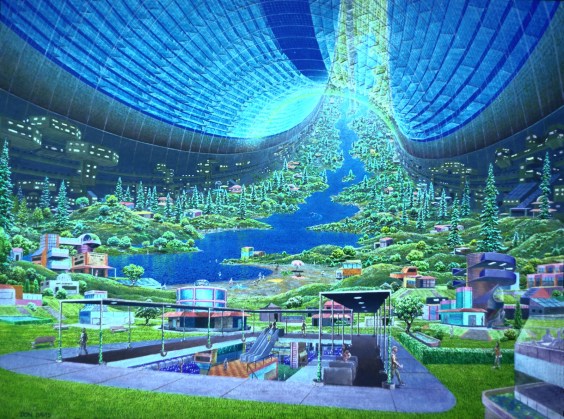
Humanity has been seriously considering building a permanent presence on the moon for at least 70 years. Earlier this year, erratic billionaire Elon Musk went a bit further, promising a “self-growing” lunar city within just 10 years. It’s kind of like the difference between adding a second story to your house and adding a self-sustaining skyscraper on top.
Or rather a lack of cold water—according to their new paper in Scientific Frontiers, a settlement at the scale of a self-growing city (100,000 to 1 million people) would be hamstrung by a lack of precious H2O. But first, some good news. The team actually crunched the numbers on both water and power requirements, and discovered generating enough electricity for a self-growing city will be a relatively lighter lift.
Because of the moon’s high silica concentrations and low gravity, building and erecting massive solar panel towers could provide enough electricity for everyone (even data centers). These structures could be placed on the sun-drenched rims of polar craters, the so-called “peaks of eternal light.” Then there’s the bad news—the “pits of eternal darkness.” That’s the term for the shadowy craters that harbor ice at a temperature of -260 degrees Fahrenheit, preventing it from evaporating. Also located primarily at the poles, these craters are estimated to hold several hundred million tons of water.
But there’s other water scattered around the lunar surface as well, so the team expanded the estimate to a generous 1 billion tons of water. Unfortunately, that’s still not enough for a self-growing city. The astrophysicists estimate these reserves will be exhausted by a city of 1 million within just a few years.
Of course with the kind of water recycling efficiency achieved by the International Space Station (a herculean 98 percent) this could be extended, but only to a century. Additionally, the moon may contain a lot less water. Given how many of his impetuous promises have amounted to vaporware, I won’t be holding my breath.
Subscribe to our free newsletter.
Extract — continue reading at the source.


/https://tf-cmsv2-smithsonianmag-media.s3.amazonaws.com/filer_public/d6/3a/d63ab0e1-1057-4fce-8f8c-c0ea8bb2ea6e/a_1-fused-groups-of-anglo-saxon-coins-found-in-recent-excavati-95fcea8df7df53c8c8b6485cc9f1e443.jpg)