The icon indicates free access to the linked research on JSTOR. A labor-saving device to lighten the domestic workload … wouldn’t that be taken up in a second? The vacuum cleaner and the electric refrigerator certainly were.
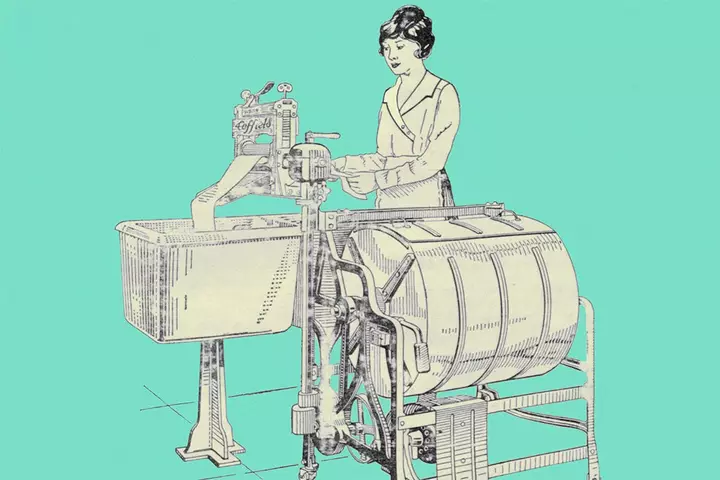
These were juiced-up variations on familiar things (brooms, iceboxes) and were welcome—if one could afford them. But electric-powered washing machines, which began to be introduced in the 1910s, had a more uphill road to acceptance at even half the price of refrigerators. It took the hard sell, going door-to-door during the 1920s and 1930s, to get washing machines in people’s homes.
As the contemporary trade publication _Electrical_ _Merchandising_ put it, the washing machine “does not add social standing, it has no luxury appeal, and no entertainment value.” Business historian Peter Scott explains that clothes-washing was the “least popular chore for nineteenth century housewives, owing to the long, heavy, and unpleasant physical labor that hand-washing required.” Those who could passed the task on to domestic workers or commercial laundries. In the American South, in particular, racial and social dynamics were a high wall for the washing machine industry. Maytag, the industry leader, simply gave up selling in the South for the first half of the 1930s.
The industry even tried “overtly racist arguments to deter southern white families from using black laundresses.” Vivid hues in everyday products became eye-popping reality in the early twentieth century. In response to this social reluctance, washing machine manufacturers and retailers resorted to high-pressure “forced selling,” as they themselves called it. They targeted blue-collar families who couldn’t afford to outsource their laundry.
When the Depression undermined this market sector, the industry switched to selling to white-collar families who were, Scott writes, “struggling to maintain a middle-class lifestyle on reduced incomes.” (Since the Victorian period, cleanliness had been a big part of the middle class’s self-image.) Two other factors pushed back against the rapid diffusion of washing machines. First, there was serious competition from the commercial laundry industry. The power laundry industry did some $700 million worth of business in 1928, the same year sales of electric washing machines for the home reached $108 million.
In 1939, there were some 6,733 power laundries and 15,245 hand laundries in the US. The National Laundry Owners’ Association and the American Washer and Ironer Manufacturers Association alternated between fierce competition—both claimed the other’s machines spread bacteria—and agreed-upon truces (1927, 1933) before another all-out advertising war and sales campaign in 1936. Second, the semiautomatic washing machines themselves may have taken some of the drudgery out of clothes washing, but they did not really save time.
Extract — continue reading at the source.